This is my personal intake on the symposium I attended last week.
On Thursday the 9th (March 2023) I attended as a guest, the
Trademark Infringement and Online Environment Symposium/ Workshop. The invitation came directly from
Prof Xuemei Bian who together with
David Humphries from UK IPO, are working on understanding the counterfeit market online and to propose a strategy. The project is funded by the British Academy and while this is based on UK, I thought the same is applicable to all jurisdictions as the online world is without frontiers.
The guests and speakers came from different backgrounds, and different industries e.g., IPO, enforcement bodies (police), Law, Criminology, data analytics, marketing, Procter and Gamble, and Alibaba. The symposium took, and the project as such takes, into consideration consultations, advise and research focusing on collaboration for actionable solutions (aka interdisciplinary / cross sectors).
Xuemei & David opened the floor to provide us with a general view on the rationale of the work they are doing and what they are aiming at. For instance, this was the second symposium / workshops that they have organised, they have done plenty of literature review based on data /statistics looking at a better understanding, that is, to identify what has been done, what is missing, and to question if the available research done up to today, is relevant. This was a moment of reflection for me: could it be that we academics are focusing too much on the research part rather that its purpose? David noted that it is crucial to understand the economic and societal influence of social media and counterfeiting. He emphasised that research can make a difference, but it seems that academia works in silos – again, this was a reflection moment for me. He continued to note that the IPO and his role is to take a ‘helicopter approach’ (looking at the overall context); noting that it is evident that protection isn’t great and there is a need to work with the evidence and establish a counterfeit strategy (Look at the Intellectual Property Counter-Infringement Strategy 2022 to 2027 here).
Evaluation of the IPO counter-infringement strategy
Marianna Lemus-Boskovitch, and Teodora Lazar, from BOP Consulting presented their research from the consumer perspective; advertising communication and how consumers react and its impact – based on counterfeits. They have done interviews to gather what sources are available and did a data gap analysis showing indicators to build upon. This was done to test what material / information is out there, stating that they did a theory approach.
David closed this part of the session by indicating that ‘monitoring and evaluation’ is a good start!
Online / Social media IP infringement
David Shepherd, Senior Lecturer in Economic Crime, University of Portsmouth presented ‘The impact of complicit social media influencers on consumption of counterfeit goods in the UK’. After showering us with charts, and statistics, I could be bias to report what I got from his presentation: women are more cautious when buying online than men! David run a survey during 2021 in both sexes and covering 16-60 yrs. old. The survey showed that 31% of men purchased endorsed counterfeits while women 13%. In any case, the majority knew they were buying a counterfeit. What is of worry, which I do agree, is that there are certain product categories, that are dangerous e.g., batteries and beauty product (due to the chemical components). He also acknowledged that there is a percentage of buyers that are ‘hunters of counterfeits’ [was I under a rock that I did not know much about it?]. The survey also revealed that we are susceptibility to trust others e.g., family, friends, and influencers, and their influence varies as it seems to be age related. Another part of the survey showed that the rationale of consumers to purchase counterfeits there was a correlation when ‘price is high, and the quality is not important’.
Ronald Brohm, managing director at REACT, intervened to talk about his experience noting that the ‘online world’ and the ‘trading’ includes apps, social media, stating that legislation is behind. Notices of ‘take down’ to links, and hiding links, seems straightforward but it gets complicated with apps and social media. A burden encountered with, is the definition of what ‘trade’ is. He explained that in China, one need to have a license to trade, and enforcement is less complex as it is easy to identify traders; and while the system is not perfect, this practice shows a good practice.
Tackling global online / social media counterfeiting -technology and implications.
Dennis Collopy, Senior Research Fellow, University of Hertfordshire, spoke about artificial intelligence and IPRs enforcement (IPO commissioned this research in 2021) how to use AI in the matter of copyright, trade marks and trade secrets infringements. He has done a literature review on the matter and conducted a survey by interviewing different individuals, e.g., from the judiciary, NGOs, etc. Looking at data mining it seems that there is a big challenge regarding training data and to use just ‘clean’ data rather than bias, and noticed the lack of transparency (due to the black box) and in general about the quantity and quality of data fed. Data must be updated constantly, needs retraining, to follow GDP compliance, finally, concluding the session, his point noted the need of a ‘revolution on Data Quality’ and that, in his opinion, the AI challenges that are identified exceeded the number of opportunities [I personally believe that we get to excited about AI without reflecting the risks] .
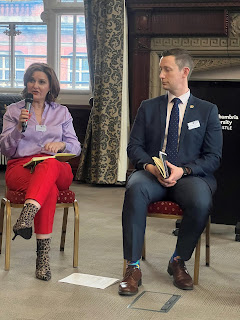 |
| Sharon [left] Andrew [right] |
From the point of view of
Andrew Masterson, a member of the PIPCU team, City of London Police he presented his experience, but also noted that how can the law enforcement rely on the AI due to the matters raised by Dennis. Another matter that was noted by
Sharon Penketh, Manager Global Brand Protection eBusiness, at Procter & Gamble, is whether companies have the resources to apply AI.
Improving IP protection and enforcement in the digital economy
Muhammad Asif Khan and Yu Ye, Assistant Professor in & Lecturer in Digital Marketing, from Northumbria University presented ‘The findings of a comprehensive systematic literature review on Trademark Infringement in the online as opposed to offline economy’. They did a systematic literature review on trade mark infringement – what information is available on this by business and management, computer science and law, extending to industry report/data. Some of the keywords used were infringement, duplicate, imitation, competing, replica, copycat, counterfeit, fake. They noted the next step will be text mining: such as a key themes and gaps in the literature; to analyse the structure of the data; and to raise potential approaches. During the talk, I was made aware of Leximancer, did you know about this? a platform that analyses text documents and in the case of IP it does an advanced trade mark similarity assessment models [did I get this info right?].
Claudio Bergonzi, Director Global IP enforcement, at Alibaba Group, concentrated in four points:
1) establishing good programmes – what IPRs are there;
2) proactive use of AI;
3) offline corporation – law enforcement (what is behind, distribution networks); and
4)cooperation with rightsholders.
For instance, he mentioned the quantity of consumers they have, in how many countries they put their products on, and how many they deal with by day. For them, it is essential to know what IPRs there are and to whom they belong to and emphasised the importance of cooperation from traders. Noted that Alibaba uses AI, and they continuously feed data. They also work heavily on identifying legitimate products – and work also on counterfeit prevention ( by recording images). Talking about fakes, he gave an example which again, I think I am living under a rock!, anyways, he mentioned influencers telling followers like ‘buy this green t-shirt from Alibaba and use this code and you will get a fake [luxury fashion brand bag]’ what?!!! He continued to cover the matter of fake reviews –which is feeding to AI.
 |
| The two posters on display |
The day closed with ‘
Seed corns for collaborative projects – the findings of PhD research project’.
Sadia Haque, PhD Researcher, Northumbria University presented ‘Brand protection marketing campaign messages, do they work and why?’
Jaishree Prasad, PhD Researcher, Northumbria University presented ‘Why should we even care about brand infringement when our brand is not counterfeited?’
I had the opportunity to speak to them before their presentation as they displayed their posters during the coffee breaks and lunch time. Both junior researchers were enthusiastic about their topics, as well as to be close to finishing this chapter of their life, a PhD. Their topics were topical to the workshop as they presented both quantitative and qualitative research on the matter of counterfeit. Jaishree made reflect upon one of her many findings, which is that the ‘impact of non-luxury brands in the sale of counterfeit bags is greater than to the luxury brands.’ And it does make sense, because rather than expending $50 in a bag from a high street shop, a consume can get from same price, a fake luxury fashion brand bag. It does harm the non-luxury shop as the consumer is their regular, that consumer will NOT buy the original luxury one. Sadia’s examined the messages delivered by campaigns to stop counterfeiting; one of her early conclusions, based on evidence, is that the ‘force’ of the message to make an impact should vary depending on the receiver. This means that we consumers, receive messages differently in accordance to our background.
A very fruitful date. Thanks for the invite and looking forward to working with you in any future project.