Welcome to our blog for Intellectual Property Law and Practice in Latin America!
¡Bienvenidos a nuestro blog de Derecho y Práctica de la Propiedad Intelectual en Latinoamérica!
Bem-vindo ao nosso blog sobre Direito e Prática de Propriedade Intelectual na América Latina!
Showing posts with label Mexico. Show all posts

Thursday, 27 October 2022

Patricia Covarrubia

Mexico: Plagiarism and traditional cultural expression

    No comments:
I received an email yesterday morning with a link to the BBC Latin America News. I am always skeptical to open links due to virus (are you not?). On second thoughts, I read the link and it was clear that was a verified page and when I clicked there were some juice news for our blog 😊 The heading reads: “Ralph Lauren apologises after Mexico indigenous 'plagiarism' claim”. My reaction was, not again! It has become usual to see big business appropriating cultural designs. But I wonder whether this is due to social media and we, as a society, are more aware of it. The era of globalization surely has made us more aware of what is going on in every corner, but also may have brought in us an appetite for merchandise that is only available in certain regions, or cultures [would you agree?]. 

Back to the news. 
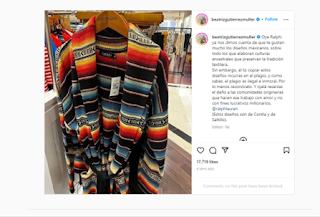
The wife of the Mexican President wrote on Instagram below the photo of the claimed item
“Hey Ralph: we already realized that you really like Mexican designs, especially those that are elaborated by ancestral cultures that preserve textile tradition. However, by copying these designs you incur in plagiarism, and as you know, plagiarism is illegal and immoral. At least acknowledge it. And hopefully you will compensate the damage to the original communities that do this work with love and not for millionaire profit. @ralphlauren (These designs are by Contla and Saltillo.)”
[translation, my own] 

Let’s put our IP hat on: is this plagiarism? Is there an infringement? Traditional cultural expression as such is not protected under the umbrella of IP. Yet, WIPO’s Intergovernmental Committee (IGC) on IP and Genetic Resources, Traditional Knowledge and Folklore is working on an international instrument for their protection. [for the drafts go to this page here). The matter is that IP has a period of protection (full stop). That is the terrible reality that traditional knowledge in general suffers. Added to this, is the fact that even if it were protected by let’s say copyright, there is the argument of ‘inspiration’ that designers rely heavily on. However, there is a fine line between ‘inspiration’ and ‘copy’, and this has been reflected more in recent years (or at least we have become aware of it). 
For instance, three months ago, we brought to you the news of Mexico vs Shein, for a garment deemed to be copied by the latter which contained Mayan’s traditional culture. Two years ago, we also posted about the Guna people in Panama vs Nike which contained a ‘mola’ design. I am sure there is not enough space to tell you all about this situation that seems to happen all over again, and again. 

Back to the news
Ralph Lauren has apologised and noted that months ago they remove it and were surprised to see the final products on display. This may be the end of the story, but not for the communities around the world. While waiting for the WIPO international instruments, there is nothing stopping governments to pass their own national laws protecting their traditional knowledge. Yet, this would be protection on their national territory, I am afraid, but at least, it is something. 

The suspicious link sent here.

Read More

Friday, 29 July 2022

Patricia Covarrubia

Mexico: cultural (mis) appropriation

    No comments:
Last week, the Mexican Secretary of Culture sent a letter to the company SHEIN asking to clarify the launch of the piece “Flower trim top with floral print” that is identical to a garment designed by the handicraft brand ‘ YucaChulas’.

The statement reads ‘” cultural elements whose origin is fully documented’, which generate economic rewards in the communities that sell them. The blouse, short huipil, was created in the Mayan communities of Yucatan, Campeche and Quintana Roo, and its design would not be possible without knowledge “transmitted from generation to generation, product of the collective creativity of the Mayan people.”’ YucaChulas also went to social media (here) to express their dismay against SHEIN due to the lack of recognition of the work made by local artisans and how plagiarism diminish and devalued their culture. Since then, SHEIN has removed the garment and noted in a statement that it was not their intention ‘to infringe anyone’s valid intellectual property and it is not our business model to do so.’

Photo: El Universal - YucaChulas left; SHEIN to the right


As you know, the protection of cultural expression through intellectual property is a heated debate. And now, WIPO has advanced in this topic – see early publication here. In the meantime, some countries, especially in Latin America, have some kind of legislation that regulates the use of traditional knowledge, but yet there is not clear procedure or enforcement, it seems like just ‘good practice’. However, one must say that the Panama Law No. 20 on the Special Intellectual Property Regime with Respect to the Collective Rights of Indigenous Peoples to the Protection and Defence of their Cultural Identity and Traditional Knowledge, seems a solid one. Others, like Colombia, continues to use Geographical Indications protecting cultural expressions and traditional knowledge, although this protects the product linked to the origin, rather than the product per se. The same strategy is used in Peru, where you will notice several ‘collective marks’. Yet, IP is territorial and these legal tools, used in Panama, Colombia and Peru as examples, only will stop the ‘plagiarised’ product to be sold in their countries, but can continue to sell it in other jurisdictions. [sad]

Read the news at El Universal MX
Read More

Sunday, 6 February 2022

Verónica Rodríguez Arguijo

Tequila: finaliza la investigación bajo el Reglamento sobre obstáculos al comercio (TBR) de la UE


El 3 de febrero de 2022, la Comisión Europea anunció que finalizó formalmente su investigación sobre la denuncia referente a obstáculos al comercio en el sentido del Reglamento (UE) 2015/1843 (Reglamento sobre obstáculos al comercio, TBR en inglés) aplicados por México y consistentes en medidas que afectan la importación del Tequila. Consulta el anuncio aquí.

La denuncia

La denuncia había sido presentada por la Asociación de Cerveceros de Europa (The Brewers of Europe) debido a la decisión del Consejo Regulador del Tequila (CRT) de “ya no [conceder] certificados de exportación a … [TdS, una empresa] que produce y exporta «Tequila» …  [a una] filial de Heineken NV … [debido a que] la cerveza Desperados de Heineken (una cerveza con aroma de «Tequila» añadido) infringe la [Norma Oficial Mexicana] aplicable a la utilización de la Indicación Geográfica (IG)” Tequila.

Durante la primera etapa de la investigación de la Comisión, intervinieron 22 partes interesadas, “en su mayoría representantes de asociaciones velando por la protección de las indicaciones geográficas europeas”. En efecto, oriGIn solicitó a la Comisión el reconocimiento como parte interesada considerando las implicaciones de la disputa en cuanto a los principios de las IG.

De igual manera, el procedimiento de examen también fue discutido por el Parlamento Europeo (lea aquí la pregunta parlamentaria planteada a la Comisión Europa, y consulte aquí la respuesta, ambas en inglés).

En mayo de 2021, la Comisión Europea finalizó el procedimiento de examen de la medida aplicada por México que afecta las exportaciones del Tequila a la UE (consulta el reporte aquí). Se concluyó “que si bien la medida plantea preocupaciones sobre el cumplimiento de México respecto de las normas de la OMC, específicamente la prohibición de restricciones a la exportación, está sujeta a una serie de procedimientos administrativos pendientes que pueden conducir a la revocación o modificación de la medida. Por lo tanto, la Comisión continuará monitoreando el resultado de los distintos procedimientos y, dependiendo de su resultado, podrá reevaluar las acciones a emprender” (énfasis añadido).

En octubre de 2021, la Asociación de Cerveceros de Europa informó a la Comisión Europea que “la empresa de la UE afectada había encontrado una solución con las autoridades mexicanas, lo que permitió la eliminación de los supuestos obstáculos al comercio”. En consecuencia, retiraron la denuncia.

*El 7 de febrero de 2022, se publicó en el Diario Oficial de la Unión Europea, la Decisión de Ejecución (UE) 2022/161 de la Comisión de 3 de febrero de 2022 por la que se da por concluido el procedimiento de examen relativo a los obstáculos al comercio, en el sentido del Reglamento (UE) 2015/1843, aplicados por los Estados Unidos Mexicanos y consistentes en medidas que afectan a la importación de Tequila. Consulta aquí la Decisión de Ejecución. 

El retiro de la denuncia y la finalización de la investigación por parte de la Comisión Europea suceden al acuerdo amistoso entre CRT y Heineken, luego de que CRT iniciara varias acciones legales en la Unión Europea que involucraban el uso de la palabra Tequila en la cerveza Desperados. Consulta aquí mi reporte sobre el acuerdo amistoso al que llegaron las partes.

Créditos:
La imagen es cortesía de Dante Gbn.

*Artículo actualizado el 7 de febrero de 2022.
Read More

Wednesday, 3 March 2021

IPTango

México: Premio IMPI a la invención mexicana 2021


El Instituto Mexicano de la Propiedad Industrial (IMPI) publicó la convocatoria del Premio IMPI a la invención mexicana 2021. 

Podrán participar en la convocatoria personas de nacionalidad mexicana dedicadas a la invención (sin afiliación) o que pertenezcan a una institución pública o privada de educación media superior o superior; centro de investigación; o micro, pequeña y mediana empresa ubicada en México.

Asimismo, los participantes deberán contar con un título de patente, modelo de utilidad o diseño industrial, otorgado de enero de 2019 a 2021 o con una solicitud de patente, modelo de utilidad o diseño industrial presentada ante el IMPI a la que se le haya notificado que procede su otorgamiento (oficio de cita a pago).

Se otorgará un premio en cada una de las siguientes categorías:

  1. Patente
  2. Modelo de utilidad
  3. Diseño industrial
  4. Innovación para micro, pequeñas y medianas empresas (patente, modelo de utilidad o diseño industrial)

Los premios serán entregados en el marco de día mundial de la propiedad intelectual. La fecha límite para participar es el 19 de marzo de 2021.

Las bases de la convocatoria pueden consultarse aquí.

Fuente: sitio web del IMPI, consultado el 3 de marzo de 2021.

Imagen de Gerd Altmann en Pixabay.
Read More

Monday, 28 December 2020

IPTango

In memory of Armando Manzanero


The IPTango team mourns the passing of Armando Manzanero, Mexican songwriter, pianist, singer, producer, and arranger. 

Worldwide famous by his romantic songs, Armando Manzanero, passed away on 28 December 2020. 

Armando Manzanero Canché born on 7 December 1935 in the city of Mérida, Yucatán. 

Considered one of the most renowned composers worldwide, he wrote over 600 songs. Out of these, more than 50 enjoyed global recognition and were performed in more than 30 languages. 

“Contigo Aprendí”, “No Sé Tú”, “Esta Tarde Vi Llover”, “Somos novios”, “Te extraño”, “Adoro”, “Voy a apagar la luz”, “Como yo te amé”, “Por debajo de la mesa”, “Nos hizo falta tiempo”, and “Mía” are some of his most famous songs. 

Among others, Frank Sinatra, Elvis Presley, Luis Miguel, Juan Gabriel, Elis Regina, Andrea Bocelli, Eugenia León, Tania Libertad, Tony Bennett and Alejandro Sanz performed his songs. 

Armando Manzanero was a strong advocate of copyright enforcement. Since 2011, he was the president of the collective management society SACM (Society of Authors and Composers of Mexico). 

Proud of his roots, he sang in Maya during a concert held in Chichen-Itzá to celebrate his 83-year career.

Armando Manzanero received several awards, including the Latin Grammy Lifetime Achievement Award (2010), the Grammy Lifetime Achievement Award (2014), and the Cultural Heritage of the Americas Award granted by the Organization of American States (2014). 

In October 2020, Armando Manzanero received the Billboard Lifetime Achievement Award “for his exceptional career that spans over six decades and which has taken Latin music to the next level internationally”. 

The Secretariat of Culture of Mexico will pay tribute to Armando Manzanero through Canal 22, Radio Educación, and the online platform “Contigo en la Distancia”. 

As stated on the SACM website: “His legacy is recorded in the history of music for Mexico’s glory in the world”. 

Listen to Armando Manzanero here and here. 


Sources: 
· Biography of Armando Manzanero published on the SACM website. 
· The review published on the website Celebrando Armando Manzanero. 
· The article “Armando Manzanero to Receive Lifetime Achievement Award at 2020 Billboard Latin Music Awards” published on the Billboard website. 

Credit: Image available on the website of the Secretariat of Culture of Mexico, accessed on 28 December 2020.
Read More

Saturday, 26 December 2020

IPTango

Mexico: the USPTO and IMPI launched the Parallel Patent Grant (PPG) initiative


On 7 December 2020, the Mexican Institute of Industrial Property (IMPI) and the United States Patent and Trademark Office (USPTO) announced the launch of the Parallel Patent Grant (PPG) initiative. 

According to the press releases, the PPG results from the Memorandum of Understanding on Technical and Strategic Collaboration (MoU) signed by the USPTO and IMPI on 28 January 2020. 

In accordance with the MoU, the two Offices would “implement a parallel patent grant framework that allows IMPI to leverage USPTO search and examination results when granting a counterpart Mexican patent”. 

Thus, under the PPG, “IMPI will expedite the grant of a Mexican patent for businesses and individuals already granted a corresponding U.S. patent”. This worksharing arrangement will make “faster for U.S. patent holders to obtain corresponding patents in Mexico”. 

As stated by IMPI, approximately 11,000 patent applications filed between 2015 and 2018 may benefit from the PPG. 

The PPG is not the first worksharing collaboration between IMPI and the USPTO, given the Patent Prosecution Highway (PPH) program has been implemented since 2011. 


Credit: Image by Guy Dugas from Pixabay.
Read More