Welcome to our blog for Intellectual Property Law and Practice in Latin America!
¡Bienvenidos a nuestro blog de Derecho y Práctica de la Propiedad Intelectual en Latinoamérica!
Bem-vindo ao nosso blog sobre Direito e Prática de Propriedade Intelectual na América Latina!
Showing posts with label plagiarism. Show all posts

Monday, 1 June 2020

Verónica Rodríguez Arguijo

Upcoming events


WHAT'S GOING ON THIS WEEK?

On 2 June 2020, the Brazilian Intellectual Property Association (ABPI) will hold the webinar Influencers: Legal and Behavioural Aspects in light of the Pandemic (in Portuguese). The speakers are Gisela Peres Neves Baptista, Gustavo Escobar, and Camila Coutinho. The moderator is Deborah Portilho. Register here

The webinar Federal Law on Plant Varieties: Myths and Realities to the Amendment to UPOV-91 (in Spanish) will take place on 3 June 2020. The event is part of the Permanent Seminar on Intellectual Property 2020-1 (PSIP) which is organized by the Legal Research Institute (IIJ) of the National Autonomous University of Mexico (UNAM). The speaker is Leobigildo Córdova Téllez, Director General of the National Service for the Inspection and Certification of Seeds (SNICS). 

On the same day, the webinar Intellectual Property Aspects of Live Streaming (in Portuguese), organized by the Brazilian Association of Industrial Property Agents (ABAPI), will be streamed on ABAPI TV (YouTube channel). The speakers are Ana Paula Borges Martins, Rafael Atab, and Cláudio Lins de Vasconcelos. The moderator is Ana Beatriz N. Guerra. 

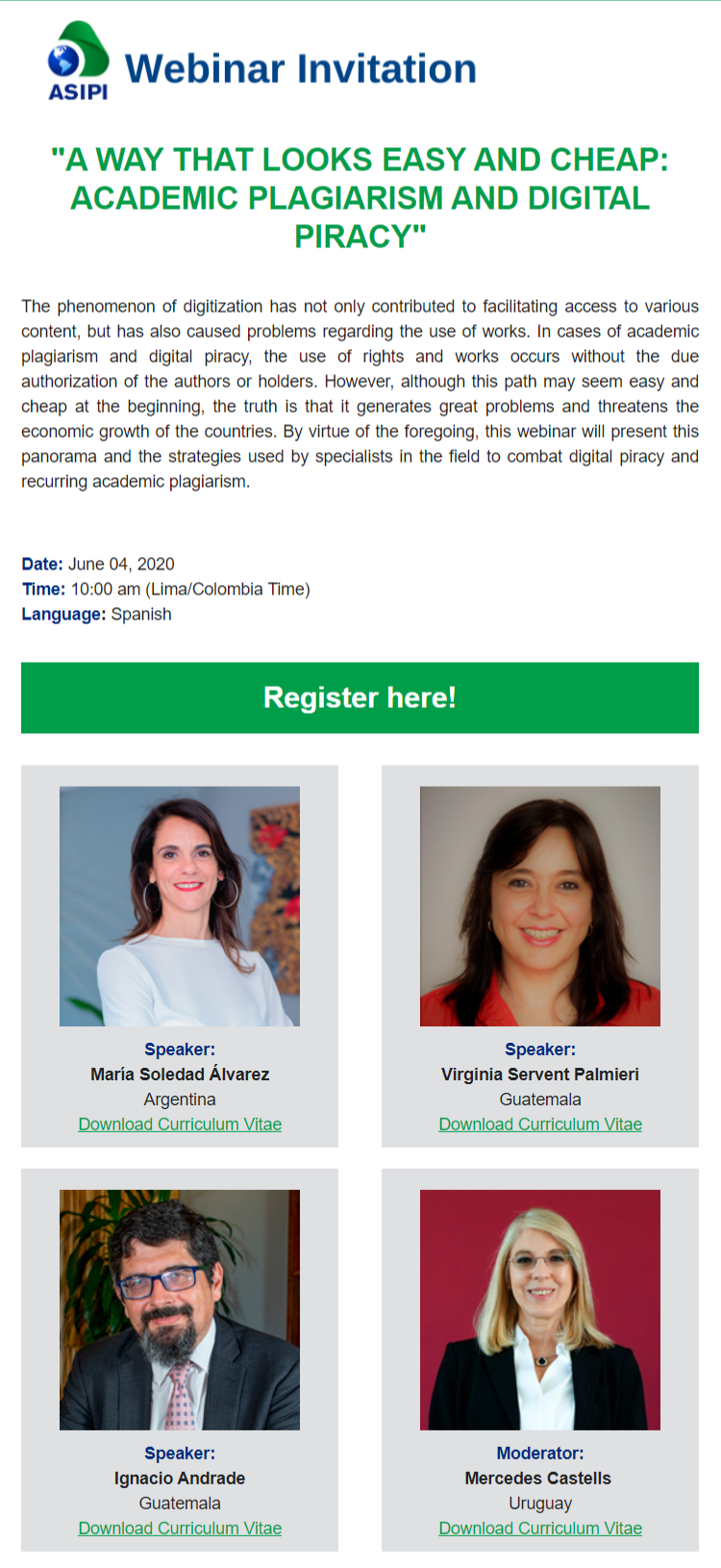
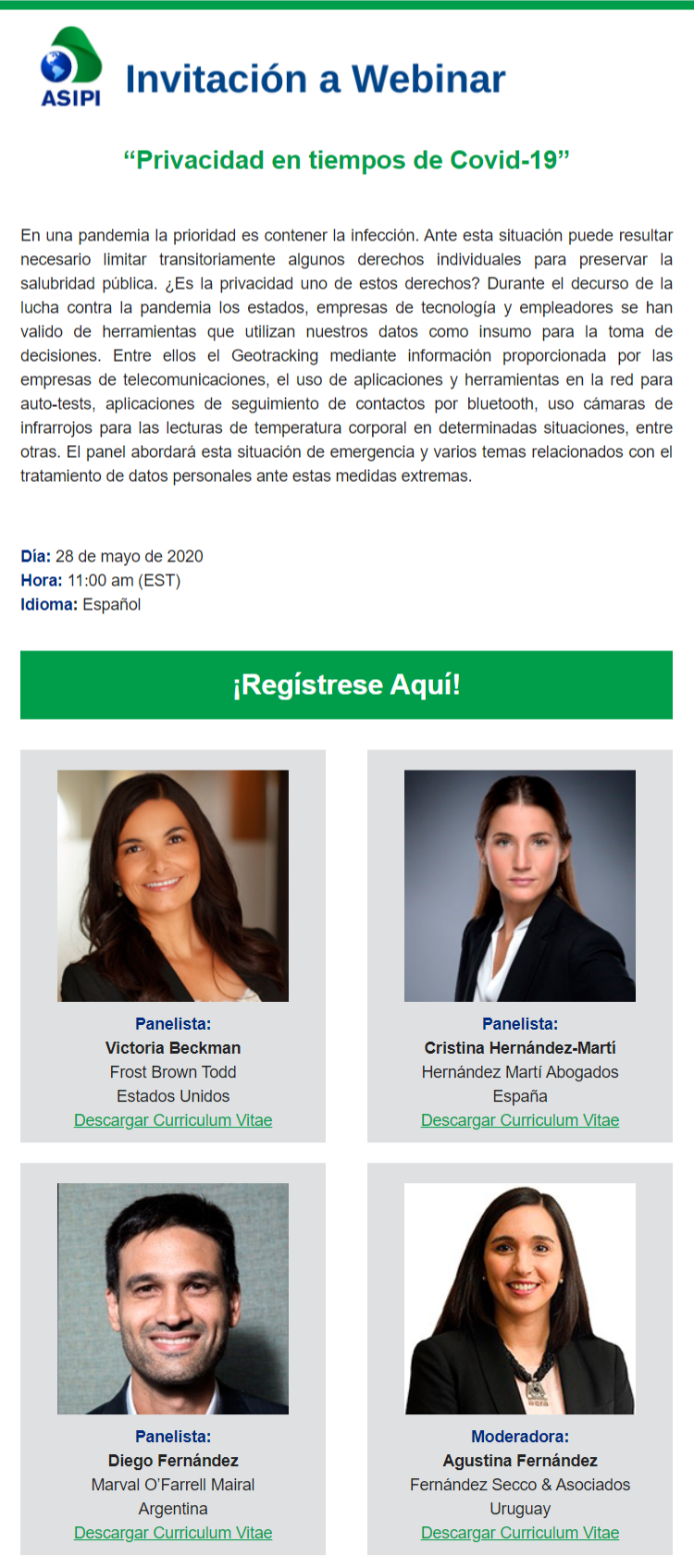
On 4 June 2020, the following webinars are scheduled: 

WIPO CONVERSATION ON IP AND AI 

The World Intellectual Property Organization (WIPO) announced the Second Session of the WIPO Conversation on IP and AI will be held online from 7 to 9 July 2020

The First Session took place in September 2019 and “brought together member states and other stakeholders to discuss the impact of Al on IP policy”. The Revised Issues Paper on Intellectual Property Policy and Artificial Intelligence containing the results of the public consultation launched after the first session can be reviewed here


PAST EVENTS 

Did you miss some events held the last week? The following are still available on-demand: 
If you have a craving for more, review the full list of events here

Read More

Thursday, 23 November 2017

Patricia Covarrubia

Parliament standards: submitting plagiarised documents

    No comments:
Yesterday the Chilean Chamber of Deputies and the Faculty of Physical Sciences and Mathematics of the University of Chile has signed a collaboration agreement to avoid plagiarism in documents.

This comes as no surprise since between 2014 and 2016, there were at least 40 deputies who paid for reports which were plagiarized by either showing verbatim copies taken from the Internet or without citing sources. The Congress therefore resorted to use an anti-plagiarism tool created by the University of Chile known as DOCODE. The software program has been created by the Web Intelligence Center of the Department of Industrial Civil Engineering of the University of Chile (WIC). The software “allows the detection of plagiarism based on technologies of text mining and natural language processing. The tool analyzes the documents that users upload and compares them with all documents indexed on the web and / or a repository of documents created by them. Then, it gives as a result a report of plagiarism in which the different sources of extraction of the document can be reviewed, being able to visit them for their reading.” According to the publication, the Chilean Chamber of Deputies would be “the only legislative body in Latin America ‘that applies a model of this type’”.

The Speaker of the House, noted that the collaboration agreements “is of enormous importance to raise Parliament's standards in terms of submitting documents such as bills, external consultancies, commission reports, etc.”. The parliamentarian also stressed that the use of this tool will place the Chamber of Deputies as the only legislative body in Latin America "that applies a model of this type, where all the works will be part of a comprehensive review process."


Read More

Monday, 15 February 2016

Patricia Covarrubia

Academic Misconduct, plagiarism, copyright infringement or just an electoral fight

    No comments:
This month Peru’s newspapers have been busy reporting about an alleged plagiarism done by Mr César Acuña Peralta who is running for the Peruvian Presidency (here and here)

Image result for plagiarismMr Acuña has been accused of copying his doctoral thesis submitted at the Universidad Complutense, Madrid in 2009. Added to this accusation, now it emerges that he also copied his master’s thesis submitted at the Universidad de los Andes, Colombia. In the latter, news referred to the fact that some paragraph were well attributed to the author and using quotations marks but others were not. The alleged paragraphs were taken from the book authored by Cruz Cardona.


Accusations are so strong that the Peruvian National Institute for the Defence of Competition and Protection of Intellectual Property (Indecopi) has decided to investigate the accusation (in line with its Organization and Functions Act and Decree Legislative 822 that gives to it powers to investigate acts affecting copyright and related rights within the country). Moreover, the Universidad Complutense has announced that “it will initiate an investigation to determine whether Acuña committed academic fraud.”

Image result for plagiarismThe Spaniard newspaper El Pais noted that Universidad Pontificia Catolica del Peru passed the thesis through Turnitin, a software which is widely used in academia that matches the document against a database, and so detecting originality or similarity to other sources. The said academic “found in the first 165 pages an average of 80 % similarity to other Internet sources not necessarily cited in the investigation.” Declarations in this newspaper refers to pages after pages of textual copying without been either attributed or using quotation marks. In many educational institutions, plagiarism is treated as strict liability (as copyright primary infringement) while others require intention. In any case, plagiarism is a disciplinary offence.

A more recent accusation was brought by the newspaper El Comercio noting that it has transpired that in 2002 Mr Acuña authored and published a book which is an identical copy of the book authored by Peruvian Professor Otoniel Oyarce Alvarado.

Wow! Wow! Wow! These are really strong accusations. A master, a PhD and a book?! I am indeed amazed how these could have happen…I presume the University in Madrid did not have or use any software to check the originality of the work, -- possibly. However, we are talking pages after pages. How the supervisors and the examiners did not notice this matter? As an academic sometimes we read students work and we stop to think, uh? I have read something like this somewhere. But we are humans, and mistakes could have happen…but in a PhD there is so many people involved, and no one noticed it? The other issue that comes into my attention is the book that he allegedly copied. If it is claimed that is a copy of another one...how did anyone not notice this before? Both books are published in Peru and written by academics in Peru – surely a student or a person in the same fora could have noticed something.

Will Mr Acuña resign from his Presidency postulation? Or will he wait for the University in Madrid and the Indecopi to give a verdict?
Read More

Thursday, 3 May 2012

Rodrigo Ramirez Herrera @ramahr

Sobreseen de imputación de plagio de "El Aleph" de Borges a escritor argentino

La acción penal por infracción de los artículos 72 y 73 de la Ley 11.723 de Propiedad Intelectual ejercitada por María Kodama, viuda de Borges en contra Pablo Katchadjian, autor de un texto intitulado "El Aleph Engordado", fue sobreseída por el juez de primera instancia del Juzgado de Inostrucción Nº 3 en lo Criminal Guillermo Carvajal.

En la resolución de dieciséis carillas, el juez determinó que no existe defraudación sobre la propiedad intelectual dado que el demandado no actuó en forma dolosa (ardid para obtener un beneficio). El magistrado consideró que no ocultó que la obra había sido “intervenida” y publicada por él fuera de Jorge Luis Borges, tanto en entrevistas posteriores a la publicación como en un postfacio a la edición en la que reconoce que el texto original de El Aleph le pertenece a Borges.

El tribunal desestimó convocar a los testigos de autoridad en teoría literaria y artística ofrecidos por la defensa, considerando el asunto como únicamente una cuestión de derecho. El plazo para apelar vence hoy. De existir apelación, la causa pasaría a Cámara, que decidirá si la sentencia queda firme o no. No obstante, el fallo deja a salvo el derecho de María Kodama puede accionar en sede civil por aplicación del artículo 80 de la misma ley 11.723, que contempla la reproducción sin autorización y el correspondiente resarcimiento.

El fallo estima que el acto de reproducción del texto de Borges es ilegal, mas no constitutivo de delito penal. De esta forma queda abierta la resolución que determine hasta qué punto modificar una obra de arte da por resultado una nueva de la que se puede adjudicar original autoría.

Según se informó en su oportunidad la heredera universal de los derechos de la obra de Borges había anticipado que accionaría judicialmente pues entendía que la reproducción del cuento, unas cuatro mil palabras, y la siguiente intervención por parte de Katchadjian –que intercaló oraciones propias para extender el texto original de Borges, aumentando hasta más del doble de palabras– era un delito por la reproducción sin autorización.

Read More

Friday, 6 April 2012

Rodrigo Ramirez Herrera @ramahr

María Kodama viuda de Borges acciona judicialmente por plagio de "El Aleph"

Ante la Secretaría Nº 110 del Juzgado en lo Criminal de Instrucción Nº 3 de Buenos Aires se ha presentado por María Kodama, viuda de Jorge Luis Borges (1899-1986), una acción judicial por infracción de los artículos 72 y 73 de la Ley 11.723 de Propiedad Intelectual contra Pablo Katchadjian, autor de un texto intitulado "El Aleph Engordado", una versión ampliada del famoso cuento "El Aleph" del fallecido escritor argentino, publicado en 1949, y reeditado en 1974.

Kodama ha demandado al autor argentino, de 34 años, por supuesto plagio, infracción que contempla penas de hasta seis años de cárcel, según informó el diario Clarín de Argentina.

El escritor imputado de plagio tiene una pequeña editorial llamada Imprenta Argentina de Poesía (IAP), donde editó 200 ejemplares de un texto en el que intervino “El Aleph” agregándole palabras, que desde las cuatro mil originales llegaron a nueve mil seiscientas, en una técnica de intertextualidad. Y lo tituló "El Aleph Engordado". El libro termina con una aclaración del autor: “el texto de Borges está intacto pero totalmente cruzado por el mío”. 

La viuda de Borges sostuvo que "[t]oma todo el cuento sin pedir autorización. Si uno usa algo que no es propio, lo mínimo que puede hacer es pedir permiso".

Normativamente los textos invocados en la acción judicial, según la información de prensa, son los siguientes:

"Art. 71. - Será reprimido con la pena establecida por el art. 172 del código penal, el que de cualquier manera y en cualquier forma defraude los derechos de propiedad intelectual que reconoce esta ley.

Art. 72. - Sin perjuicio de la disposición general del artículo precedente, se consideran casos especiales de defraudación y sufrirán la pena que él establece, además del secuestro de la edición ilícita:

a) El que edite, venda o reproduzca por cualquier medio o instrumento, una obra inédita o publicada sin autorización de su autor o derechohabientes;

b) El que falsifique obras intelectuales, entendiéndose como tal la edición de una obra ya editada, ostentando falsamente el nombre del editor autorizado al efecto;

c) El que edite, venda o reproduzca una obra suprimiendo o cambiando el nombre del autor, el título de la misma o alterando dolosamente su texto;

d) El que edite o reproduzca mayor número de los ejemplares debidamente autorizados".

A su vez, el art. 172 del Código Penal argentino inserto en el Título sobre "Delitos Contra la Propiedad", Capítulo IV de las "Estafas y otras defraudaciones" dispone que: "Será reprimido con prisión de un mes a seis años, el que defraudare a otro con nombre supuesto, calidad simulada, falsos títulos, influencia mentida, abuso de confianza o aparentando bienes, crédito, comisión, empresa o negociación o valiéndose de cualquier otro ardid o engaño".

Fuente: EFE/ clarin.com
Read More

Thursday, 17 June 2010

Patricia Covarrubia

Waka waka chorus – who is the author?

    1 comment:
The official theme of the 2010 South African World Cup is under debate. The singer and songwriter, Wilfrido Vargas, accused Shakira of plagiarism for the use of the chorus of his song titled “ el negro no puede' in the ‘wake waka’ song – the official theme of the 2010 World Cup.

The chorus ‘waka waka' became famous in 1982, in the voices of a Dominican band called ‘las chicas del Can’ (the 'Sugar Babes' of the time) by the musician Wilfrido Vargas, who composed the song ‘el negro no puede’ and included a chorus:
“Zamina mina he he. Waka Waka ee e. Zamina mina zaaangaléwa. Ana wam a a, yango e e, yango ee e. Zamina mina zaaangaléwa. Ana wam a a”

You can hear the chorus here - by ‘las chicas del can’, and here by Shakira.

The question is who copy who? Or, who owns any rights over the chorus?
According to the news, in early May, FIFA announced that it had chosen the theme "Waka Waka", explaining that the chorus was based on a Cameroon song. It continues explaining that the song ‘waka waka’ is old as the people of Africa and that the unique name Zangalewa belongs to the popular song of Cameroon. Also, in 1986, a band from Cameroon called ‘Golden Sounds’ launched its version of "Zangalewa" and became very popular.

Although Shakira has twice been accused of plagiarism, there has never been any legal proceeding against her. Could this time be the one? Looking at the info, I do not think so. I guess Shakira can answer with her song ‘where are the thieves?'

A litte bit of gossip
For those of you who are seeking to know which ones were the other two songs, I will give you more info. Actually, I do remember both songs and saying to myself...this is like x.
1.- "Hips Do not Lie." – who can forget this song, or Shakira dancing it! Do you remember Jerry Rivera and his song ‘Amores como el nuestro’... the tune arrangement played by the solo - trumpet? Exactly the same.
2.- "Hips Do not Lie." The Dominican singer and writer, Luis Días, also accused Shakira for taking the chorus ‘baila la calle de noche, baila la calle de dia’ from his song titled ‘baila la calle’.

I really enjoy today written this post and searching/listening all the info about the songs. Latin music - salsa, merengue, ron, domino, football, weather, food; these all make me feel home sick. What a wonderful culture we have.
Read More