Welcome to our blog for Intellectual Property Law and Practice in Latin America!
¡Bienvenidos a nuestro blog de Derecho y Práctica de la Propiedad Intelectual en Latinoamérica!
Bem-vindo ao nosso blog sobre Direito e Prática de Propriedade Intelectual na América Latina!

Monday, 22 August 2011

Aurelio Lopez-Tarruella Martinez

Guadalajara (Mexico), 29-30 September 2011: Latest Trends on GIs

Our colleagues from orGIn (Organisation for a Geographical Indication Network) have sent IP Tango quite interesting information concerning the International Conference that will be held in Guadalajara (Mexico) on 29-30 September 2011 about the "Lastest Trends on Geographical Indications".

Besides the conferences by prominent speakers such as Francesca Toso (WIPO) or Jose Rodrigo Roque Diaz (IMPI), participants will have the chance to visit Tequila.

Read More

Wednesday, 17 August 2011

Gilberto Macias (@gmaciasb)

México: Procedimiento Acelerado de Patentes

Desde marzo de 20011, el Instituto Mexicano de la Propiedad Industrial (IMPI) se ha integrado a la nueva tendencia internacional y ha puesto en marcha el Procedimiento Acelerado de Patentes (PPH - Patent Prosecution Highway) en conjunto con la Oficina de Patentes y Marcas de Estados Unidos (USPTO)

El mecanismo del PPH es una práctica que comienza a extenderse alrededor del mundo. En 2006 inició con la Oficina de Patentes y Marcas de Estados Unidos y la Oficina de Patentes de Japón; actualmente más de 12 oficinas de patentes, incluida la Oficina Europea de Patentes, han incorporado dicho programa.

Gracias al PPH las oficinas de patentes pueden acelerar el proceso de examen de patentes mediante el uso, en la medida de lo posible, de los resultados del examen de fondo obtenidos por las oficinas signatarias.

Entre las principales ventajas del programa del PPH, se destaca que:

a) Se reduce en gran medida el tiempo de realización del examen de fondo o novedad, ya que este examen disminuye de 27 meses, tiempo regular, a tan solo un periodo aproximado de 3 meses;

b) Se incrementa la probabilidad de obtención de la patente hasta en un 90%, sobre las mismas reivindicaciones ya aprobadas en la primera oficina; caso contrario al sistema tradicional en el que la probabilidad de concesión se reduce hasta el 50%.

El IMPI ha extendido su compromiso con la Oficina Española de Patentes y Marcas (IMPI-OEPM) y con la Oficina Japonesa de Patentes (IMPI-JPO).

Con estos acuerdos, las oficinas se podrán beneficiarse del trabajo realizado previamente por la otra oficina, lo que reduce la carga de trabajo de examen y mejora la calidad de las patentes. El examen expedito en cada oficina permitirá a los solicitantes obtener las patentes correspondientes más rápido y de manera más eficiente en cada país.

Más información aquí (Englsih Press_Release)
Read More
Patricia Covarrubia

Google is an uncontrollable monster!

    No comments:
Brazil, 15 August, Google Brazil Internet Ltda. brought an appeal to the Brazilian Superior Court of Justice (STJ) for having been obliged by a lower court to remove offensive content placed in Orkut - a social network and discussion site operated by Google.

The party affected, a health specialist in Rio Grande do Sul, claimed the removal of all offensive messages and images. It is claimed that the doctor suffered a wave of attacks on the network and he tried to use an existing tool on the site to prevent the transmission of the defamatory messages. The tool, however, did not allow the exclusion of all messages against him. He asked also for compensation for moral and material damage.

Google however claimed that it would be impossible to scan the network for defamatory content against the party affected and thus, claimed that the doctor should have provided the email address of the attackers and indicate the measures to be censored.

The company also argued that if they proceed to remove the content, this would violate the freedom of expression. Moreover, it mentions that there is no legislation requiring Internet Service Providers (ISPs) to exert control of content placed on the Internet.

STJ
The Fourth Class of the Supreme Court did not consider the liability of the ISP. It only found that Google is obliged to delete the defamatory content of the pages struck against the victim, even without the provision of accurate email addresses from him.

The rapporteur, Luis Felipe Minister Solomon, considered that the lack of technical tools to correct problems does not exempt the company to seek solutions. "If Google has created an uncontrollable monster, it is only to be charged for any consequences generated by the lack of control users have of its social network," he said. Offensive messages could be captured by programming mechanisms or by a specialized staff, he added.

Yet, the responsibility is not automatic and does not occur at the time the message is posted on the network. The civil liability depends on the conduct, taking into consideration its responsibility and the damage experienced by others.

Process: REsp 1175675
Read More

Tuesday, 16 August 2011

Rodrigo Ramirez Herrera @ramahr

Litigio por marca Arroz Gandhi en Ecuador


En Ecuador (IEPI) está teniendo lugar un litigio por el registro de la marca “Arroz Gandhi”, que tiene enfrascados en una disputa a un abogado de la India (Lalit Bashin) y al solicitante del Ecuador Ana Doris Valverde Muñoz. Esta última ha solicitado el 26 de marzo de 2010 el registro para la clase 30 del clasificador de Niza de la marca "Arroz Gandhi" (solicitud 226973) para arroz, frente a lo cual se ha deducido el 15 de marzo de 2011 oposición por Bashin. El oponente  funda su demanda en que el tipo de producto (arroz en diversas variedades) puede generar riesgo de confusión en cuanto a su procedencia desde la India y, principalmente, porque registrar como marca la denominación "Arroz Gandhi", que en inglés se traduce como "Gandhi Rice", es casi una blasfemia en dicho país, pues podría herir los sentimientos del público en general que ha venerado y respetado a Mahatma Gandhi como el Padre de la Nación. También sostuvo en la petición que nadie se puede permitir comerciar con el nombre y la imagen de Gandhi pues es un líder de fama mundial. Agregó que la Ley India de Emblemas y Nombres (Prevención de uso indebido) de 1950 (The Emblems and names [Prevention of Improper Use] ACT, 1950) protege a "Gandhi", como un emblema nacional indio donde nadie puede usar el nombre o la representación pictórica de Mahatma Gandhi o Gandhi en una marca o un diseño sin la autorización del Gobierno de la India. El solicitante no respondió la oposición el 12 de julio y el 10 de octubre tendrá lugar el próximo estadio procesal. Este litigio viene a relacionarse con el art. 6 ter del Convenio de París, que ha sido objeto de entradas y comentarios anteriores a propósito de otras materias (marca país).

Fuente principal: www.lawetalnews.com vía Shamnad Basheer (Spicy IP)
Read More

Friday, 12 August 2011

Rodrigo Ramirez Herrera @ramahr

ONAPI y OMPI realizan programa de formación en República Dominicana

La Organización Mundial de la Propiedad Intelectual (OMPI) y la Oficina Nacional de la Propiedad Industrial de República Dominicana (ONAPI) iniciaron el "Programa de Formación para formadores en la Gestión Efectiva de los Activos de Propiedad Intelectual (PI) para las Pequeñas y Medianas Empresas" (Pymes) que comenzó el lunes 9 de agosto y culmina hoy en el auditorio del Centro de Exportación e Inversión de la República Dominicana (CE·IRD). 


La iniciativa tiene como objetivo contribuir con la formación de los recursos humanos de las Pymes en materia de gestión de activos de PI, para beneficio de los sectores interesados y de la producción nacional. La actividad se enmarca dentro del Plan de la Academia Nacional de la Propiedad Intelectual (ANPI), de manera preliminar para que al momento de la puesta en funcionamiento de la ANPI -cuya inauguración será el próximo 29 de agosto del presente año- República Dominicana cuente con un número importante de formadores tanto de la ONAPI como de la Oficina Nacional de Derecho de Autor (ONDA).


Juan José Báez, Director General de ONAPI, informó que "la OMPI a través de la Academia Mundial y la División de Pymes está confiando en nosotros, por lo que nos convertimos en el primer país de la región del Caribe y Centroamérica donde se implementa este programa dirigido única y exclusivamente para PYMES". Baez aseguró que esto es el resultado de ser los primeros en implementar las guías de la OMPI para este segmento de la producción nacional cuyo objetivo principal es básicamente el uso de las referidas guías.

El programa contempla talleres, mesas redondas y exponencias a cargo de profesionales nacionales e internacionales, expertos en materia de propiedad intelectual, entre los que se destacan los señores Marco Marzano de Marinis, Administrador de Programa, División de Pequeñas y Medianas Empresas de la OMPI, Gustavo Schotz, Director del Centro de la Propiedad Intelectual de la Universidad Austral de Buenos Aires, Argentina y la abogada Josefina Moreno Garcia, de México. De República Dominicana participan técnicos de la ONAPI entre ellos Ayalibis Garcia, Ivette Janet Vargas, Victor Ramirez, Carolina Morales, Carlos Medina, Raquel Núñez, Arlette de La Rosa, Lesli Franco, Josefina Aquino, Diana Cordero, Ramona de Aza, Narcis Tejada, entre otros

.
Read More

Thursday, 11 August 2011

Patricia Covarrubia

's' is the letter: shrimp and sweets from Brazil

    No comments:
The Brazilian Instituto Nacional da Propiedad Industriale (INPI) has granted two geographical indications (GI) – published last Tuesday 9th of August.

The first one is camarões da Costa Negra (Black Coast shrimp) cultivated in artificial ponds in the towns of Acaraú, Itarema and Cross. The GI form sought by the Association of shrimp farmers of the Black Coast (ACCN) was as a Designation of Origin (DO) which will be the second for a national product. The product has features and qualities like high protein content and a sweet taste, due to the geographical environment of the region, including soil and water, and human factors involved in the cultivation technique.

The second is doces de Pelota (sweets of Pelotas), a municipality about 250 km from Porto Alegre, Rio Grande do Sul. The soil characteristic of the region encourages the planting of fruit trees such as peaches, quinces, among others, used for the production of jams and later for the manufacture of sweets.

From this date both Associations have a period of 60 days to pay the fee required and once comply with, INPI will issue the said certificate.

GI in Brazil
Brazil recognises Geographical Indication in two forms: Denomination of Origin (DO) and Indication of Source - DO is more valued because it depends on proof that the product has special characteristics due to geographical and human factors all together.

On August last year, (INPI) granted the first Denomination of Origin to a Brazilian product - granted to ‘Litoral Norte Gaúcho’ for rice.
There are 5 DO pending for other national products: Cerrado Mineiro for coffee and ‘Vale dos Vinhedos’ for wines which enjoy indication of source (IS) already. The other three DO applied for are for stones.


Read More

Wednesday, 10 August 2011

Aurelio Lopez-Tarruella Martinez

IPR Chapters in FTAs Costa Rica - China and Peru-Korea

On August 1st, two new Free Trade Agreements entered into force: Costa Rica-China and Peru-Korea.

Following the trend in recent bilateral agreements around the world, both FTAs include Chapters on Intellectual Property. While they do not include standards as high as those imposed by EU or US in their FTAs, it is interesting to see that they do contain some substantial provisions, in particular the one between Peru and Korea.
The FTA between Costa Rica and China includes specific provisions on generic resources, traditional knowledge and folklore and on geographical indications apart from general obligations to comply with TRIPS and Doha Declaration on Public Health, and on technical cooperation. There is a provision on border measures as well.
The FTA between Peru and Korea provides for similar obligations in these same fields, but it also include provisions on copyrights and related rights and extended provisions on enforcement.

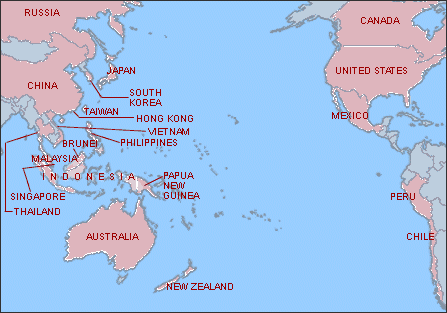
These treaties are just another manifestation of the increasing relevance of trade relations between Asia-Pacific and Latin American countries. It would be interested to see the effects on the international protection of IPR of the regulation of trade relations among them. In this sense other important negotiations to follow are those of the Transpacific Partnership Agreement or TPP. Here is a good article on that in Spanish.
Read More

Wednesday, 3 August 2011

Rodrigo Ramirez Herrera @ramahr

Chulucanas reconocida en Chile como primera Denominación de Origen extranjera

Hoy martes 2 de agosto de 2011 el Instituto Nacional de Propiedad Industrial de Chile (Inapi) dictó la resolución administrativa por la cual concede registro para la clase 21 del nomenclátor de Niza a la Denominación de Origen peruana "Chulucanas" solicitada bajo el número 801167 por la República de Perú el 27 de diciembre de 2007. El signo distintivo se aplica a cerámicas, que se caracterizan por la arcilla cuya zona de extracción es el distrito de Chulucanas de la provincia de Morropón departamento de Piura y las técnicas empleadas que son las rescatadas de las antiguas tradiciones culturales de la zona geográfica. El nombre geográfico corresponde a la zona de producción, extracción y elaboración de los productos. El distrito de Chulucanas limita por el norte con el distrito de Frías (provincia de Ayabaca), al sur con el distrito de Catacaos (provincia de Piura), al este con los distritos de la Matanza, Morropón y Santo Domingo, y por el oeste con los distritos de Castilla (provincia de Piura) y Tambogrande (Sullana).

Como primera denominación de origen extranjera otorgada bajo el nuevo sistema de registro chileno, creado en el año 2005, el Director Nacional del INAPI, Maximiliano Santa Cruz, entregará al Embajador de Perú una copia de la resolución que reconoce a “Chulucanas” en Chile.

La cerámicas originarias del distrito de Chulucanas son, desde el año 2005, utilizadas por el gobierno peruano para posicionar a Perú como “marca país” en los mercados internacionales.

Fuente principal: Diego Ponce G. (Comunicaciones Inapi Chile)
Read More

Thursday, 28 July 2011

Patricia Covarrubia

Brazil: a royalty fee affair

    No comments:
The company CLUBE VIDALONGA PROGRAMA DE CONDICIONAMENTO FÍSICO LTDA ('the club' from now on) had used publicly music in its commercial activity without permission of authors and other copyright holders. Because of this, the Central Bureau of Revenue Collection and Distribution ( ECAD) brought an action against the Club to pay the fee due, plus default interest. Both parties appealed but only ECAD obtained leave to appeal.

The Terceira Turma do Superior Tribunal de Justiça (STJ) heard the appeal. The ECAD claimed that the Tribunal de Justiça do Rio de Janeiro (TJRJ ) did not consider the right of the author to price the use of his work by others. It also argued that the values set out in its Rules of Collection for the fines are binding on the parties who make use of its members’ works.

The minister Massami Uyeda, rapporteur of the appeal, acknowledged that indeed copyright holders have the prerogative to fix the value for the use of their work. However, Law 9.610/98, which regulates the copyright, does not expressly determine these values when there is an illicit use. Therefore, values of fines, interest and other charges arising from such actions are determined by civil legislation and not by the Rules of ECAD.

Finally, it was said that the unauthorized use of artistic work does not create a contractual relationship between the user and the author - it bypasses the contractual relationship and does not create links between them. With this reasoning, the minister denied the appeal of ECAD supported by all members of the Terceira Turma of the STJ.

An overview of the case can be read here.
The stages of the case here.
Read More

Wednesday, 27 July 2011

Patricia Covarrubia

Handicraft becomes a 'handy' GI in Brazil

    No comments:
This week the Brazilian Instituto da Propriedad Industrial (INPI) published the granting of the Geographical Indication (GI) in the form of ‘Indications of Source’(IS) to clay pots Goiabeiras. From the date of the publication, the Association of Paneleiras Goiabeiras has 60 days for the payment of the regulatory fee. After this requirement is fulfilled certification of registration will be issued.

The clay pots Goiabeiras are made with clay removed from Vale do Mulembá in the island of Vitoria, Espirito Santo. The tannin, used for sealing parts, is obtained from red mangrove bark. Both the extraction of clay and the removal of tannin are made in a sustainable manner, ensuring compliance with environmental legislation.

The INPI also informs that with the registration of clay pots Goiabeiras, it brings to eleven the number of Brazilian products with certified origin through GI. This is the second for a handcrafted product – last month INPI granted GI to craft of golden grass Jalapão.
Read More