Welcome to our blog for Intellectual Property Law and Practice in Latin America!
¡Bienvenidos a nuestro blog de Derecho y Práctica de la Propiedad Intelectual en Latinoamérica!
Bem-vindo ao nosso blog sobre Direito e Prática de Propriedade Intelectual na América Latina!

Monday, 10 January 2022

Verónica Rodríguez Arguijo

[Guest Post] Mercado Libre’s second Transparency Report


IPTango is pleased to publish a guest post by Francisco Burguete, discussing the second Transparency Report published by Mercado Libre.

Mercado Libre (MELI) published its second Transparency Report, which covers data from January to June 2021 and includes a new section on user information requests (see here IPTango post on MELI’s first Transparency Report).

MELI emphasized that in the second report, “the scope of information available to users, authorities and civil society organizations has been expanded[, and for] the first time, information requests from authorities that are processed in compliance with the law are shared”.

Now, the Transparency Report comprises four main sections: user information requests (section one), product security and quality (section two), protection of IP rights (section three), and privacy matters (section four).


Product security and quality (Section 02)

This section contains information about removed content because of violations of MELI’s Terms and Conditions (T&C), such as offering prohibited items on the platform (e.g., items violating IP rights):

  • 267,461,670 listings were placed on MELI’s websites as of 30 June 2021 (compared to 331,607,978 listings in the first report).
  • 8,815,828 listings were detected and moderated by MELI due to violation of its Listing and Prohibited Items Policies (compared to 18,570,436 in the previous reporting period).
  • 53,173 listings were reported by users (compared to 112,424 in the previous report).
  • Top jurisdictions concerning detected listings regarding the violation of MELI’s Listing and Prohibited Items Policies:

Jurisdictions

Detected Listings (1st report, as of 31 December 2020)

Detected Listings (2nd report, as of 30 June 2021)

Brazil

13,283,854

4,013,453

Mexico

2,282,461

2,311,539

Colombia

1,371,060

1,240,494

Argentina

792,168

253,219

Chile

609,413

581,119

Uruguay

98,915

150,475

Peru

96,569

174,077

Rest of Latin America

35,996

91,452

  • Only 4.5% of detected listings were reactivated (compared to 3.12% of reactivated ads).
It should be noted that the second report contains the top main content infringing categories broken down per country. Meanwhile, the categories were classified only per product in the first report.


Protection of IP rights (Section 03)

In this section, MELI presents its Brand Protection Program (BPP), which “enable IPR holders to report infringing listings [via a Notice & Take Down -N&TD- procedure]”. MELI emphasized that they have developed “self-mapping tools, based on artificial intelligence, to “learn” from the notices received and proactively remove listings” that infringe IPRs.

  • 969,413 N&TDs were submitted (compared to 2,107,264 in the previous reporting period).
  • 56,432 counter-notices were submitted (compared to 104,661 in the first report).
  • The number of Proactive Detections and Confirmed Complaints:

Date

Proactive Detections

Confirmed Complaints

2021-1

1,322,070

159,409

2021-2

907,771

170,128

2021-3

1,558,342

206,285

2021-4

733,493

132,261

2021-5

760,860

117,082

2021-6

668,668

125,850


The English version of the second Transparency Report can be reviewed here. The Spanish version is available here.

In the past, IPTango interviewed Juan Cichero (Head of Brand Protection at MELI), who conversed about BPP, the N&TD procedure, and more. Read here the interview.
Credit: Image by athree23 from Pixabay.
Read More

Friday, 31 December 2021

Verónica Rodríguez Arguijo

Happy New Year! / ¡Feliz Año Nuevo!


This is the last article of the year, and we want to thank our readers, followers, and authors of all guest posts!

We are thrilled and grateful that to this day, the blog has received over 1,831,300 page views since its creation!

Happy New Year to all! 


Este es el último artículo del año, ¡y queremos agradecer a nuestros lectores, seguidores y autores de todas las publicaciones invitadas!

¡Estamos encantados y agradecidos de que, hasta el día de hoy, el blog haya recibido más de 1,831,300 visitas desde su creación!

¡Feliz Año Nuevo a todos!


Image by Gordon Johnson from Pixabay / Imagen de Gordon Johnson en Pixabay.

Read More

Sunday, 19 December 2021

IPTango

[Nuevo Libro] La propiedad industrial y el derecho de autor en Iberoamérica: tendencias para la tercera década del Siglo XXI


Recientemente fue publicada la obra colectiva "La propiedad industrial y el derecho de autor en Iberoamérica: tendencias para la tercera década del Siglo XXI", Hugo R. Gómez Apac (et al., directores).

El libro fue editado por la Universidad Internacional del Ecuador, la Universidad Hemisferios y la Asociación Ecuatoriana de Propiedad Intelectual (AEPI).

Los autores son de Argentina, Brasil, Colombia, Ecuador, España, México, Paraguay, Perú, Venezuela, entre otros países.

La obra comprende tres ejes temáticos. En la primera parte se abordan temas relacionados al derecho de autor y derechos conexos. Dicha sección contiene artículos sobre la justificación y evolución del derecho de autor, la protección de las culturas populares y expresiones culturales, el impacto de internet sobre el derecho de autor, los mecanismos alternativos de solución de controversias, entre otros.

En la segunda parte, se comprenden temas en materia de propiedad industrial. En esta sección se incluyen artículos sobre patentes, modelos de utilidad, marcas e inteligencia artificial, marcas notorias, infracciones, entre otros.

En la tercera parte se abordan temas de propiedad intelectual en sentido amplio. Esta sección contiene artículos sobre el régimen común de propiedad intelectual de la Comunidad Andina, inteligencia artificial y propiedad intelectual, entre otros.

A la luz de la publicación de la obra colectiva, el 13 y 14 de diciembre de 2021 se llevó a cabo un seminario virtual, cuyos videos están disponibles aquí.

La obra colectiva puede consultarse aquí.

Crédito: imagen disponible en la cuenta de Hugo R. Gómez Apac en Twitter.
Read More

Sunday, 21 November 2021

IPTango

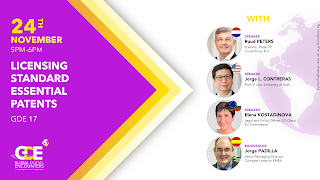
Encounter 17: Licensing Standard Essential Patents


On 24 November 2021, FIDE (Legal and Business Research Foundation) and TIPSA (Transatlantic Intellectual Property Academy) will hold the Encounter 17: Licensing Standard Essential Patents.

The panellists are Ruud Peters (Peters IP Consultancy), Professor Jorge L. Contreras (University of Utah) and Elena Kostadinova (European Commission). Dr. Jorge Padilla (Compass Lexecon) will moderate the session.

The suggested readings and the report on the session will be available on the Global Digital Encounters (GDE) website as time goes by.

The Encounter is offered free of charge, but registration is required. Register here now!

If you missed previous Encounters or you want to watch them again, click here.

Credit: The image is courtesy of FIDE.

UPDATE: the recording of Encounter 17 is available here. 
Read More

Friday, 19 November 2021

Patricia Covarrubia

Brazilian IPO – weekly news roundup

    No comments:

Read More
Patricia Covarrubia

"Cómo proteger y promover su cultura - Patentes" - OMPI webinar

    No comments:

Read More

Wednesday, 10 November 2021

Patricia Covarrubia

Re-schedule: geographical indication, definition, management, sustainability and consumers

    No comments:

 Will you be there?

I just go news from the Agricultural Research for Development (CIRAD) and the Food and Agriculture Organization of the United Nations (FAO) about its international conference. I published the invitation a while ago but due to the pandemic, it did not take place....NOW IT WILL :)

by Kenny Stoltz
The conference is on the 12th to 15 th July, 2022 and the location...oh my!...Montpellier, France [I honestly do not know if I am excited because it is finally taking place or because of the location]. The conference will be in person (so we can raise a glass - or two :)) but will provide 'virtual' access for those that cannot travel due to health concerns.

So tell us, what is the most recent research you have been discussing with your peers in the GI world? Would you like to share this with us? The deadline is 1st Dec,2021.

What are we expecting, what topics?

Nature and legal definition, public and private management, impacts in the marketplace and outside the market, sustainable development including social dimensions and the protection of biodiversity and environment, relationships with other intellectual property rights, engagement with other formal and informal forms of norm-making, consumers’ welfare, competition policies, technical innovation and terroir effect, collective organization and collaboration, participation and empowerment of local actors: these are some of the topics that will feed the debates in this conference.

For more information click here (English) and here (Spanish


Read More

Tuesday, 9 November 2021

IPTango

[Guest Post] Brazil: Bill No. 12/2021 on compulsory licensing of patents


IPTango is pleased to publish a guest post by Pedro Matheus and Leonardo Cordeiro (Gruenbaum, Possinhas & Teixeira), discussing the Brazilian bill No. 12/2021 on compulsory licensing of patents in cases of national or international emergencies, public interest or public calamity nationwide.


On 11 August 2021, the Brazilian Senate approved the Bill No. 12/2021 to amend the Brazilian Industrial Property Law and regulate the compulsory licensing of patents in cases of declaration of national or international emergencies or public interest by the Executive, or recognition of a state of public calamity nationwide by the National Congress.

The Bill No. 12/2021

The Bill establishes “rules and deadlines compatible with the urgency of the situation”, as well as a “power-duty of action by the Executive when facing the declaration of a National Interest Emergency”.

However, despite the alleged noble purposes, it seems the Bill does not imply significant changes to the compulsory licensing procedure already set forth via decree No. 3.201/1999. Likewise, it’s difficult to foresee how it will objectively solve the problems concerning the acquisition of COVID-19 vaccines in Brazil.

The Bill establishes some new rules and sets deadlines regarding the compulsory licensing procedure, such as a duty of the Executive to issue a list of the patents and patent applications that could be potentially useful during an emergency or exceptional situation (article 71, §2), as well as the participation of public organizations, research, and education institutions (such as universities) and other entities in the procedure (article 71, §3). However, it is not yet clear which patents could theoretically be subject to compulsory licensing since no previous studies point out which patents could be listed to be licensed due to the new Bill.

Moreover, Brazil is not a producer of Active Pharmaceutical Ingredients (API), mainly imported from India and China. Thus, it is also not clear how to license pharmaceutical technologies to “manufacturers with proven technical and economic capability”, according to article 71, §6 of the Bill, especially considering that the vaccines currently being produced in Brazil are already subject to transnational contracts, such as the ones between Instituto Butantã and Sinovac, and Fundação Oswaldo Cruz and AstraZeneca.

In this sense, even if there are patents regarding COVID-19 vaccines to be potentially licensed, Brazilian manufacturers would still depend on importing foreign APIs and know-how, which is one of the bottlenecks of the Brazilian COVID-19 vaccination program.

The logistics of importing foreign vaccines and APIs is the main bottleneck of Brazil’s vaccination and not the exclusivity of certain products due to the issuance of patents. It is important to note that Brazil has an exemplary vaccination program due to the capillarity of its system. According to the data of the National Plan for the operationalization of the vaccination against COVID-19, there are approximately 38 000 vaccination locations around the country and a population that, majority, responds positively to the call to receive their vaccine jabs.

As mentioned above, the licensing of any patent does not seem to tackle this issue since merely licensing a technology does not necessarily provide the means to reproduce such technology immediately.

In the view above, the Bill may also have an electoral connotation. Indeed, 2022 will be an electoral year in Brazil, and one of the main criticisms of the current Brazilian government has been the acquisition of vaccines and the handling of the pandemic.

The Bill became Law No. 14.200/2021 on 2 September 2021. However, the President used his veto to override a few provisions, such as the requirement for a patent owner to transfer know-how and provide supplies of medicines and vaccines, which, according to the veto’s text, would be challenging to implement and could discourage investments in technology and the formation of strategic commercial partnerships, such as the ones already mentioned above.

Comments

The new Law aims to clarify and establish rules for a procedure that already existed in Brazilian Law (the compulsory licensing of patents), and which has been reserved for moments of crisis when a patent holder is unable to properly provide the object of a patent that is strictly necessary to tackle and overcome such situation. Nevertheless, it is not yet clear how such a procedure would apply to the current COVID-19 pandemic and if it was indeed necessary to face the current situation since compulsory licensing was already established and could have been used if it was indeed essential.

On a final note, it is necessary to highlight that the Brazilian Congress opted to establish these new rules and regulations through amendments to the Industrial Property Law. In contrast, the previous regulations were set forth via presidential decree No. 3.201/1999, following a proper legislative technique.

Thus, if there is a need to establish new rules and deadlines in the future or to amend any other provision of the regulations, such amendments would require a new bill to be approved by the Congress (Federal Senate and the Chamber of Deputies), which could take more time than the issuance of a new presidential decree.

The Law has already entered into force, but the Brazilian Congress can still maintain or overrule the Presidential decision regarding the vetoed provisions.

Credits:
First image by Alexandra_Koch from Pixabay.
Read More

Friday, 29 October 2021

IPTango

INTA’s 2021 Annual Meeting: Registration closes soon!


The International Trademark Association (INTA) will hold the 2021 Annual Meeting Virtual+ from 15 to 19 November 2021.

The hybrid event includes virtual education sessions, business development opportunities, and social networking activities.

Likewise, one-day in-person mini-conferences featuring top-notch speakers and informal networking will take place as follows:

  • 16 November: New York, USA.
  • 17 November: Berlin, Germany.
  • 18 November: Los Angeles, California, USA.

This year, more than 150 speakers from 30 countries are on the agenda. The program covers the following topic tracks: building a better society through brands, the business of brands, enforcement and anticounterfeiting, innovation and the future of IP, and regional updates. Review here the virtual program.

The registration closes on 29 October 2021 at 11.59 (EDT). So far, more than 2 600 professionals from 100 countries have already registered. Out of these, 650 will also be attending the mini-conferences.

More information here.

Image by Free-Photos from Pixabay.

Update 29 October 2021: The registration deadline has been extended. New deadline: 8 November 2021 (EDT).
Read More

Wednesday, 27 October 2021

Patricia Covarrubia

The IPTango Experience in IP Studying and Teaching

    1 comment:
I have the wonderful experience and indeed the privilege to have been invited to participate in the European Intellectual Property Teachers’ Network (EIPTN). The aim of the network is to share good practices and ideas that benefit in not only the classroom but also education in general. My contribution was on how the IPTango blog has helped me as a student, researcher and teacher in the area of IP. As you can see, I needed to start from who I am, and share my journey. 

Blogs as communication technologies
I can confidently say that today we apply communication technologies in our classrooms, in our networks and even with family. It has become part of our lives. On education, it has improved our classroom with spaces that are open and flexible in the learning and teaching process. While we may agree that such tools can be used as ‘learning tools’ as the literature assert, I wanted to bring something else to the table, that of ‘inclusivity’.

Me and blogs 
I am from Venezuela and of course I am a minority in the English classroom but also I have a learning difficulty, I have dyslexia – again an ‘existing’ minority in the classroom. Certainly, as a student I felt alienated. Consequently, the impostor syndrome hit me (and still does, I am not going to lie) until the beautiful journey of a blog started. My formed LLM supervisor introduced me to the IPKat and the most new (at the time) Latin America blog IPTango. 
These were my steps:
1.- Knowledge construction: I used the blogs for education purposes. I learnt from them, as they were short pieces (digestible to me) – they were readable, the layout, colour and images were appealing to my mind. Once I felt comfortable, I move to the next stage 
2.-Collective Knowledge: reading the comments was in another league! So many ideas, controversial opinions, discussions where I started to open with confidence my ‘critical analysis’. The blog provided me with a space to do so by the construction of knowledge from different perspectives. 
3.- Reflective writing: I was brave enough to write a comment myself :) - but hey, making sure that mine was not the first one. The reflective writing came by acquiring the collective knowledge from both blogs, mainly I was enlighten by the legislation in Europe but reflecting on how on EARTH are we planning to practice this in Latin America, let alone in Venezuela. Why do we keep ‘borrowing’ legislations? Can we just not take good practices and see how we can build proper procedures to our society? 

The whole process made me feel a part of a community. I started to feel that I was included in the conversations, I felt representing a region – we did have a voice.

From a student to a teacher
I notice that a blog is more conversational (although I do not see many comments in the actual IPTango post, I do receive private messages, invitations, collaborations, etc apart from 99% junk messages). I also feel that the relationship between teacher and student becomes better using this tool, as a student I have great conversations with my teachers about recent post and now as a teacher there is not a class that someone will note a ‘recent post’. To extend the area, I invite my students to follow blogs as part of the further reading, my natural instinct is to follow the IPKat cousins (or friends) but I am sure everyone have their own favourite. 

Facilitating bridges
Blogs are a knowledge generator, it is a learning tool, it includes everyone and in all honesty, there is so much info out there that is not ‘legit’, that I rather guide them before they go surfing in troubled waters. Foreign students in EU classrooms come to this region to learn and therefore the information and knowledge must be of the region. However, are we as teachers not facilitators too? We need to encourage students at large to reflect in their learning. In the classroom, it works both ways: the foreign students may find their own voice by reflecting on their society. Local students get to know other societies and cultures. We then facilitate the classroom, corridors and cafeteria for that rich dialogue start among students. The use of a blog then creates a bridge in the students’ community. It allows the participants to create arguments, contradict practices, express hypothesis, or if to shy, by just reading and listening a blog builds on them knowledge and acknowledge their presence. 

The full EIPTN Conference papers can be found here.
Read More