Tuesday, 8 November 2022

Thursday, 27 October 2022

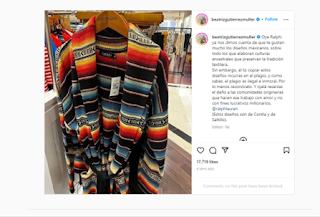
Mexico: Plagiarism and traditional cultural expression
“Hey Ralph: we already realized that you really like Mexican designs, especially those that are elaborated by ancestral cultures that preserve textile tradition. However, by copying these designs you incur in plagiarism, and as you know, plagiarism is illegal and immoral. At least acknowledge it. And hopefully you will compensate the damage to the original communities that do this work with love and not for millionaire profit. @ralphlauren (These designs are by Contla and Saltillo.)”[translation, my own]
Thursday, 29 September 2022

El Índice Mundial de Innovación de 2022: Latinoamérica y el Caribe
- Oleada derivada de la era digital, basada en la supercomputación, la inteligencia artificial y la automatización. Efecto: tener una amplia incidencia en la productividad de todos los sectores y en todos los ámbitos de investigación científica.
- Oleada de innovación en ciencia profunda, basada en avances en la biotecnología, la nanotecnología, el desarrollo de nuevos materiales y otras ciencias. Efecto: cambiar por completo las innovaciones en la salud, la alimentación, el medio ambiente y la movilidad (cuatro campos de importancia clave para la sociedad).
Monday, 19 September 2022
.jpg)
2.° Congreso Internacional de Propiedad Intelectual: Nuevas Fronteras de la Propiedad Intelectual y Tecnologías Disruptivas
- El derecho de autor frente a la brecha de valor: ¿Una oportunidad para los autores o una grieta que no cesa?
- La propiedad intelectual en el laberinto digital: usos del Blockchain e IA en la trazabilidad de obras.
- Tejer redes: el uso de las obras y los creadores de contenido en redes sociales
- Entre el verso y el metaverso: uso de propiedad intelectual en mundos digitales
- NFT: ¿final de la euforia o nuevos usos en el desarrollo de la propiedad intelectual?
- Captar valor, gestionar y construir calidad de vida: el efecto positivo de la PI en escenarios de desarrollo tecnológico
- Del otro lado del mostrador: Experiencias de incorporación de nuevas tecnologías en las oficinas de LATAM
- Player One: la vida como un videojuego
Thursday, 25 August 2022

6th Session of the WIPO Conversation on IP & Frontier Technologies: AI Inventions
- What are the market trends, and how do these translate in terms of patent applications?
- How autonomous is AI?
- What role does it play as part of the inventive process or as an invention?
- What questions does this raise for the IP system?
- How are IP Offices supporting AI inventors?
Tuesday, 2 August 2022
Peru: the FIVE instruments of accession [I got it wrong]
On July the 18th we published in this blog that the executive president of the Peruvian Intellectual Property Office (Indecopi) submitted, during the Sixty-Third series of meeting of the Assemblies of the member states, five instruments of accession.
At the time, the news was that one of them was the Geneva Act of the Lisbon Agreement (re. denominations of origin and geographical indications), and I was quick to ‘guess’ that one could have been the Madrid System. At the end I reported on others that were still pending. Well…I got it wrong, my wonderful and desirable guess was not so brilliant after all. Peru is putting this in the ‘long overdue’ to do list, and I said overdue because Colombia, a counterpart in the EU FTA together with Peru, started to work towards this back in 2012.
The other guesses were: Locarno Agreement (re classification for industrial design); Strasbourg Agreement (re classification for patent); Nice Agreement (re classification for marks); and the Vienna Agreement (re classification for marks that consist or have a figurative element). All of them consist of international classification, which will appear in official documents and publications relating to the registration and renewals of the designs, patents, and marks respectively, the NUMBERS of the categories, DIVISIONS and SECTIONS of the Classification to which the design, patent and marks belong to.
| Photo: Proarándanos |
To read the news click here.
Friday, 29 July 2022
Mexico: cultural (mis) appropriation
Friday, 22 July 2022

Asamblea General de la OMPI avanza hacia la celebración de conferencias diplomáticas sobre diseños y conocimientos tradicionales asociados a recursos genéticos
Monday, 18 July 2022
Peru: WIPO Geneva Act
The Sixty-Third series of meeting of the Assemblies of the member states is taken place at WIPO headquarters (Geneva, 14th-22nd July). While the event is taken place in a hybrid format, the Peruvian delegates are present. Specifically, the executive president of the Peruvian Intellectual Property Office (Indecopi), noted face-to-face to the counterparts, ‘the initiatives and advances of Peru in the field of intellectual property’. [more info here]
| The Geneva Walk - walking towards WIPO, June 2016 |
In particular, it was disclosed that Peru will deposit its instruments of accession to five treaties, including the Geneva Act of the Lisbon Agreement, which shows ‘commitment as a country’. There is not other indication of what other Treaties or Agreements those would be, but if we are to guess, one maybe the Madrid System, which now covers 128 countries. From Latin America:
- Brazil (Madrid Protocol, October 2019;
- Chile (Madrid Protocol, 2022);
- Colombia (Madrid Protocol, August, 2012);
- Cuba (Madrid Agreement, December, 1989; Madrid Protocol, December 1995);
- Mexico (Madrid Protocol, (Madrid Protocol, February 2013).
Regarding Geographical Indications (GI), the three countries,
that is Colombia, Ecuador and Peru, amended and or adopted GI legislation in a
manner similar to the EU. The EU deposited its instrument of accession
to the Geneva Act of the Lisbon Agreement on 26 November 2019, and in force
since February 2020.
Any other guess? Peru is not yet pat of the Hague Agreement,
Nice agreement, Locarno Agreement, Strasbourg Agreement, Vienna Agreement, Nairobi
Treaty, Patent Law Treaty and Washington Treaty – which of these, do you think
they are going to go for?
Monday, 27 June 2022

Paraguay: news with no news
From the Paraguayan IPO I read the news about the Mercosur – Singapore Free Trade Agreement (FTA).
Last week, the 6th round of negotiations seemed to end with some consensus on the matter of intellectual property, covering trade marks, patents, design, traditional knowledge and geographical indications. The meeting took place online and was led by the coordinator of the IP section Juan Esteban Aguirre, who is the Director of the International relations at DINAPI (Dirección Nacional de Propiedad Intelectual – that is, Paraguay national IP).
Previous round covered: access to the goods market, rules of origin, commercial defense, technical barriers to trade, investment, electronic commerce, services, telecommunications, government procurement and institutional aspects, trade in services, public purchases, and electronic commerce. The Foreign Trade Information System (SICE) publishes all documents relating to the negotiations, but it has not been updated (last doc is the 4th table of negotiation - April 2022).
MERCOSUR is a trade bloc in South America (Argentina, Brazil, Paraguay, and Uruguay – Venezuela was suspended in 2017) and represents the 5th world economy. The largest exports from MERCOSUR in 2022 is to China (USD$ 31,532 M); same with imports.
In 2019, MERCOSUR concluded FTA with the EU (more info here). An FTA cut hassle involved in exporting and importing goods and services, could it be by the reduction or removal of custom duties and or simplifying custom procedures.Some FACTS on IP
All FIVE countries are members of the WTO and consequently have incorporated the TRIPS agreement into their national legislation – minimum standard of IP.
- Madrid System (trade mark international register): Brazil and Singapore are members
- Hague System (design international register): Singapore is a contracting party
- Patent Cooperation Treaty (patent international register): Brazil and Singapore are members
Good to know – Brazil
The Brazilian IPO may challenge clauses establishing that improvements developed by the licensor may only be used by the Brazilian company upon the execution of a new agreement. Law No. 4,131/1962 regulates foreign capital in Brazil .
INPI assessment and approval of Technology Transfer and IP licensing agreement are mandatory for the purposes of:
- authorizing remittance of royalties to foreign licensor, grantor of IPRs recognized in Brazil;
- trigger tax deductibility by the Brazilian party of amounts paid in connection with IP license, acquisition; and
- entitle the Brazilian party to enforce licensed, granted IP rights.
Other IP facts in Brazil:
- INPI neither annotate agreements nor issue certificate of registration for the license of non-patented proprietary technological knowledge.
- INPI does not accept ‘technology’ licenses and establishes that the technology is permanently transferred to the Brazilian recipient.
- Software agreement registration is not required unless it involves the transfer of source code and know-how.
For more information in Latin America, have a look at the vast information hold at Latin America IP SMEs Helpdesk here.
Source DINAPI.