Welcome to our blog for Intellectual Property Law and Practice in Latin America!
¡Bienvenidos a nuestro blog de Derecho y Práctica de la Propiedad Intelectual en Latinoamérica!
Bem-vindo ao nosso blog sobre Direito e Prática de Propriedade Intelectual na América Latina!
Showing posts with label TK. Show all posts

Thursday, 27 October 2022

Patricia Covarrubia

Mexico: Plagiarism and traditional cultural expression

    No comments:
I received an email yesterday morning with a link to the BBC Latin America News. I am always skeptical to open links due to virus (are you not?). On second thoughts, I read the link and it was clear that was a verified page and when I clicked there were some juice news for our blog 😊 The heading reads: “Ralph Lauren apologises after Mexico indigenous 'plagiarism' claim”. My reaction was, not again! It has become usual to see big business appropriating cultural designs. But I wonder whether this is due to social media and we, as a society, are more aware of it. The era of globalization surely has made us more aware of what is going on in every corner, but also may have brought in us an appetite for merchandise that is only available in certain regions, or cultures [would you agree?]. 

Back to the news. 
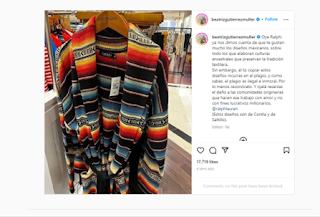
The wife of the Mexican President wrote on Instagram below the photo of the claimed item
“Hey Ralph: we already realized that you really like Mexican designs, especially those that are elaborated by ancestral cultures that preserve textile tradition. However, by copying these designs you incur in plagiarism, and as you know, plagiarism is illegal and immoral. At least acknowledge it. And hopefully you will compensate the damage to the original communities that do this work with love and not for millionaire profit. @ralphlauren (These designs are by Contla and Saltillo.)”
[translation, my own] 

Let’s put our IP hat on: is this plagiarism? Is there an infringement? Traditional cultural expression as such is not protected under the umbrella of IP. Yet, WIPO’s Intergovernmental Committee (IGC) on IP and Genetic Resources, Traditional Knowledge and Folklore is working on an international instrument for their protection. [for the drafts go to this page here). The matter is that IP has a period of protection (full stop). That is the terrible reality that traditional knowledge in general suffers. Added to this, is the fact that even if it were protected by let’s say copyright, there is the argument of ‘inspiration’ that designers rely heavily on. However, there is a fine line between ‘inspiration’ and ‘copy’, and this has been reflected more in recent years (or at least we have become aware of it). 
For instance, three months ago, we brought to you the news of Mexico vs Shein, for a garment deemed to be copied by the latter which contained Mayan’s traditional culture. Two years ago, we also posted about the Guna people in Panama vs Nike which contained a ‘mola’ design. I am sure there is not enough space to tell you all about this situation that seems to happen all over again, and again. 

Back to the news
Ralph Lauren has apologised and noted that months ago they remove it and were surprised to see the final products on display. This may be the end of the story, but not for the communities around the world. While waiting for the WIPO international instruments, there is nothing stopping governments to pass their own national laws protecting their traditional knowledge. Yet, this would be protection on their national territory, I am afraid, but at least, it is something. 

The suspicious link sent here.
Read More

Friday, 11 September 2020

Patricia Covarrubia

Today! Don't forget the 'event' TK and IP

    No comments:

 As noted early on the week under 'upcoming events on this week', today is the day to attend the webinar by the World Intellectual Property Organization (WIPOE-commerce and Intellectual Property for Indigenous Peoples and Local Community Entrepreneurs

I will be in attendance, will you?

The majority, if not all of our countries in Latin America are rich in genetic resources and traditional knowledge. Many do indeed protect traditional handicraft under Geographical Indications and for instance, Panama has a sui generis Law 20 (2020) which aims to protect TK and TCEs.

In Brazil, there are many local products that have benefited from GI protection (as a sui generis system), and some of them were globally seen in the Olympic games Rio 2016 (opening ceremony). Here you can see a very helpful map of GIs in Brazil.

In Colombia, there are 11 Denominations of Origin granted to handicraft, one of them is the weaving products 'Wayuu' referring to the Wayuu indigenous people. Check out (here)  the list of DOs already granted in Colombia. 

For more inside in how TK is seen as economic activity, check out this paper (available here) that I wrote back in March 2019 (IIC). Remember, GI has the potential to benefit rural communities, but there is some instance that there is no gold at the end of the rainbow. 


Read More

Wednesday, 18 September 2019

Patricia Covarrubia

Intangible Cultural Heritage, Intellectual Property and the Politics of Development

    No comments:
The Enredados network (policymakers, academics, and practitioners in the fields of intellectual property (IP) and intangible cultural heritage (ICH)) is pleased to invite you to a seminar and panel discussion.

Intangible Cultural Heritage, Intellectual Property and the Politics of Development
Christoph Antons (University of Newcastle, Australia)

In countries of the “developing world”, intangible cultural heritage is important for both national development policies and the rights claims of local and indigenous communities. All intangible cultural heritage is originally local, but national governments tend to shift it to the national level in the interest of nation building and income from tourism. Where communities have migrated or live across borders drawn by colonial powers, this has triggered disputes between neighbouring countries, whereby governments use different national histories and interpretations of an often mystical past to support heritage claims. Law as an instrument of the state has supported this centralisation of heritage claims and administration in the initial stages.

Image result for christoph antons
Antons' latest edited volume
Recently, however, communities have begun to articulate their own regional and local interests in heritage and are finding some support from constitutional reforms strengthening human rights and supporting decentralisation policies. Such decentralisation policies in turn were triggered by a paradigm change in development policies which aimed at a reduction of what was perceived as central government corruption and at a better sharing of resources with regions and provinces. The presentation will show the bargaining in this context about intangible cultural heritage (and related royalties) between communities, communities and governments and between the governments of neighbouring countries. In claiming what they perceive to be their rights, the parties involved use frequently changing combinations of legal principles with varying degrees of validity and legitimacy, drawn in particular from intellectual property law, international law, environmental law, constitutional law and customary law. The presentation will focus on examples from Southeast Asia, with brief comparative observations related to developments elsewhere.

Place: Coventry University London Campus
Middlesex Street, London, UK
Date: Monday 23 September 2019
Time: 5.30pm-8pm
*FREE ENTRANCE*


Enredados aims to encourage debate on the following issues:

  • the relationship between IP and ICH safeguarding;
  • the intersections between IP and ICH-related policy; and
  • how IP protection might be used as a tool for safeguarding ICH.


See you there.

Read More

Monday, 27 May 2019

Patricia Covarrubia

The Guna people to Nike: Just don't Do It

    No comments:
@Isaac Larrier
A limited edition by sportswear Nike is a trending topic. The shoes were to be a tribute to Puerto Rico but the Guna people, the second largest indigenous community in Panama, objected to the design. The said design was a ‘mola’, which is a protected traditional design by the community. The design in question are the traditional 'mola' patterns which feature colourful, swirling designs and geometric or figurative drawings. This art is ‘passed on stitch by stitch from mothers to daughters and bears witness to the Guna vision of the cosmos and their harmonious relationship with nature’.
Read More

Wednesday, 31 October 2018

Patricia Covarrubia

Traditional Knowledge and YOU!

    No comments:
I am not known as a selfish person, unless I am asked to share a chocolate cake; but looking to the amazing opportunity brought by WIPO I just wanted to keep it to myself!

Huichol's TCE, Mexico
The WIPO Traditional Knowledge Division is advertising an internship for 2019 taken place in Geneva. It is for an initial period of six months, which can be renewable for six months more. The post is addressed to those that have a background in intellectual property (IP) law, and an advanced degree (Master, PhD etc.). Particularly, they are looking for those that have an ‘interest in the relationship between IP and traditional knowledge, genetic resources and/or traditional cultural expressions.’[basically, me!].

For more information, check their web-page here. For you to be eligible, your advance degree should have been granted within a maximum of two y
ears from the completion of the studies [so, not me ;(].
Read More

Thursday, 8 March 2018

Patricia Covarrubia

Genetic Resources and Patent Applications

    No comments:
From the Brazilian Instituto Nacional da Propriedade Industrial (INPI) we became aware that as of the 27th February, 2018, INPI will start to issue formal Official Actions (Official Bulletin Code No. 6.6.1) for all patent applications filed in Brazil covering inventions related to the access to national genetic heritage and/or associated traditional knowledge (TK) - (código de despacho 6.6.1).

This will be automatically issued in all patent applications filed with INPI and so, applicants need to provide proof of registration and / or authorization of access to access to national genetic heritage and/or TK within 60 days of publication in the Revista Eletrônica da Propriedade Industrial (the Brazilian Official Bulletin).The applicant shall produce a Guia de Recolhimento da União (GRU) which is a ‘positive’ declaration to the access to national genetic heritage and/or TK. According to INPI, if the applicant does not provide such proof within 60 days, ‘it will be considered that there was no access to the access to national genetic heritage and/or TK, and INPI will continue the examination of the patent application.’ [wait…INPI will continue? so what is the point?]

INPI also informs that this formality is needed ‘because Law 13,133 / 2015 establishes that, for the purposes of regularization in INPI of patent applications applied for during the validity of Provisional Measure No. 2.186-16 / 2001, the applicant must present the
proof of registration or authorization of access to the national genetic heritage and /or associated TK within one year counted from 06/11/2017.’…does it mean that INPI will continue examining the application but yet will not grant the patent because there is a need to this formality?


I don’t feel supportive of this notification made by INPI. It is like…hello, please submit the proof, if you don’t, then no worries we’re still going ahead with examining your application. This guidance or declaration made by INPI should have been better defined and actually challenging the applicants, e.g. ‘no proof no examination’ (especially in an office that suffers from backlog). Firstly, a company continuing with their application will just want to test the waters with their invention and once they see that they have a chance of being successful, then would look for the proof of registration and / or authorization of access to the national genetic heritage and / or associated TK.

Source INPI.
Read More

Monday, 11 December 2017

Patricia Covarrubia

Food for thought

    No comments:
Last month we advertised a conference i.e. Heritage Across Borders. This was now extended to 31st of December, 2017.

Under the session Tangible and Intangible and under the title: 'Intellectual Property and the Protection of Intangible Cultural Heritage: Emerging Themes and Challenges in Transboundary and Diaspora Contexts' I submitted a proposal that may be of interest to you [and I definitely will need your help with this paper]. In this proposal I am linking Intangible Heritage, Intellectual Property and Latin America.

You perhaps have heard that back in 2009, UNESCO supported the project to safeguard the intangible cultural heritage of the ‘Aymara’ communities of Bolivia, Chile and Peru. This was to be a 5 year project and I have not heard much about how did it go i.e. has this improved Aymara’s TK?
The Decision of the Intergovernmental Committee 4.COM 15B here, aimed to identify and prepare a catalogue of the Aymara’s TK [excited to read this catalogue (anyone?)]; it also involved to promote and disseminate Aymara’s oral and musical expressions, and moreover to support TK on the production of textile arts.

Here you have then an idea of what a proposal looks like or at least starts as…just put your minds to work and hopefully I will see you in China.

Original post here.
Read More

Tuesday, 14 November 2017

Patricia Covarrubia

Heritage Across Borders

    No comments:
The above conference has been advertised by the UK Society of Legal Scholars (SLS) as well as other forums.

I would like to further up upon this since I am co-ordinating three sub-sessions in this exciting Conference taking place in China. They are under the session Tangible and Intangible. The invitation is as follow:

Intellectual Property and the Protection of Intangible Cultural Heritage: Emerging Themes and Challenges in Transboundary and Diaspora Contexts
Since the Intangible Heritage Convention was adopted by UNESCO in 2003, intangible cultural heritage (ICH) and its parallel concepts such as traditional knowledge (TK) and traditional cultural expressions (TCEs) have been increasingly important subjects of debate in several other international forums, such as WIPO, CBD (including its Nagoya Protocol), WHO, and the WTO. As more countries implement the Convention, national policy-makers and communities of practice have been exploring the use of intellectual property (IP) protection to achieve ICH safeguarding outcomes (as well as other political and economic goals). For example, inscription of ways to make food and craft products on the Lists of the Convention is often associated with efforts to register geographical indications to protect use of the names of those products.
The intersection between ICH safeguarding and IP protection raises questions about the nature of ownership or stewardship over ICH, the appropriate nature of any kind of IP protection, and its likely effects. Many of these issues have been discussed in the context of the WIPO Intergovernmental Committee on Genetic Resources, TK and TCEs, but there has been relatively little debate about protecting IP rights in transboundary heritage, especially concerning safeguarding under the UNESCO Convention. Much ICH is shared (and contested) across national borders, and can easily be translated to and practised in new locations, which poses challenges for protecting IP rights, especially in the absence of widely-ratified international agreements.
This session will consider various strategies (legislative or otherwise) to establish and/or protect IP rights over ICH in transboundary and diaspora contexts, and how they might affect efforts to maintain practice and transmission (safeguarding) of that ICH. Session papers may present case studies of IP protection regarding transboundary ICH, and/or the role of measures such as provisions for mutual recognition and national treatment, IP chapters in international, regional or bilateral trade agreements, contractual agreements under the Nagoya Protocol, and ethical guidelines and dispute resolution mechanisms. Papers may include references to all forms of intellectual property, including patents, copyright, design rights, trademarks (certification marks and collective marks), geographical indications, and sui generis rights.

The session will involve a triple session (two speaker sessions and one panel session). The speaker’s session will consist of 4 people each, and the panel session (single session) will consist of 8 speakers with a special focus on food heritage and IP protection.

Deadline for submissions: Thursday 30 November 2017

Let me know if you need more information. You can communicate to me informally about any project you feel will be suitable to the conference (or anything else – IP related of course :0).

More information here.
Read More

Thursday, 28 September 2017

Patricia Covarrubia

Peru: examples of good practice

    No comments:
The Peruvian Institute of the Fair Competition and Intellectual Property recently attended the Asia-Pacific Economic Cooperation (APEC) Forum, held in Ho Chi Minh City, Vietnam.
National experts from the different areas of IP were attending diverse workshops and meetings at the event.

Traditional Knowledge
Peru showed itself as the leading economy in protecting indigenous peoples' collective knowledge by putting forward a virtual platform related to the TK linked to the biodiversity of the country. In this session of the forum, particular discussion was held “regarding the protection of ancestral knowledge of Peruvian indigenous peoples, in order to preserve and defend them against misappropriation by third parties [by national Law No. 27811]”. Such virtual platform would also see the linking of the TK holders with the potential users, such as universities and research centres.
Peru is part of the Andean Community (CAN). Back in 1996 CAN passed Decision 391 which became the first law in the world to establish general principles for the protection of TK. By 2000 Decision 486 on the Common Industrial Regime for the Community built upon such principles and
created further measures for a defensive protection of TK.
Peru is the second largest Amazonian country and 35% of its population its indigenous. In 2002 Peru passed a law (27811) for the protection of collective knowledge of indigenous peoples related to biodiversity and in 2004, Peru created the National Biopiracy Prevention Commission (Law 28216).

Inventions and New Technologies
Experts on the subject attended the seminar "Opportunities and Challenges in the Marketing of Protected Vegetable Varieties in the APEC region". In this session the national experts talked about "Success stories “sharing Peruvian examples relevant in the commercialization of plant varieties. INDECOPI informs that the information imparted in the seminar was also shared in another seminar organised by the Vietnam Ministry of Agriculture and Rural Development, aimed at Vietnamese professionals, researchers and companies.

Trade Marks
Specialists on this topic participated in the workshop: "Delimitation of trade marks and infringements in a border context".

Source INDECOPI
Read More

Tuesday, 9 February 2016

Patricia Covarrubia

Ecuador: repealing its IP law for a code of social economy

    No comments:
Ecuador is fully engaging in its debate over the proposed ‘Código Orgánico de Economía Social del Conocimiento, la Creatividad y la Innovación (Organic Code of Social Economy of Knowledge, Creativity and Innovation) -- known as ‘Codigo Ingenios’ (Intellects Code).

The bill went to the Ecuadorian Assembly back in June 2015 as an initiative of the Ministry of Higher Education, Science and Technology (Senescyt ) supported and drafted with the help of different sectors including the Ecuadorian Intellectual Property Office (IEPI). The current Intellectual Property Law will be repealed when the new bill is approved. The proposed code comprises four books and over 500 articles. According to the newspaper ‘El Comercio’, its strengths are in intellectual property, access to the Internet and protection of ancestral knowledge.

Image result for codigo ingeniosSeveral conferences inviting students from different Universities, the legal profession, the civil society and civil servants are taken place. Moreover, the IEPI promotes the code as aiming to move “from a primary export economy to a social economy of infinite resources” and thus, noting the need to protect “the Ecuadorian knowledge and human talent”. The aims are on 11 principles: “right to share knowledge, economic incentives to encourage innovation, cheaper drugs, boost domestic inventions, internet as a basic service, support and enhancement of research, long life technology, promotion of free software, combat biopiracy, profitable mining, and the right to traditional knowledge that belong to indigenous peoples and nationals.”

According to IEPI’s director, the bill targets knowledge and entrepreneurship, but ensuring the protection of the creators’ rights. You may ask: isn’t this the purpose of their own current IP legislation? It appears that it does not. In the words of Senescyt’s secretary, the current IP “law has failed, because it is excessively private and excessively commercial and has produced nothing of innovation" [has there been any national investment on research --you will reap if you have sown, right?]. He continues saying that the code will guarantee all IPRs in all lucrative activities in academia or research and help to circulate their works and products, which I do concur. But, I am afraid I cannot see how the present IP legislation does not already protect these.

There are two other matters that I would like to address. It is asserted that the change of law is needed and that there is a need to have this code on social economy. I do wonder: is IP and IP law a legislation for social economy? The propanga surrounding the Code re-emphasizes that the current IP law only protect the rich, transnational companies, big pharmaceutical companies, foreigners and does nothing for ‘the people’ (referring to those of not enough resources). I am afraid IP protects inventions, creation, works of art, brands, regardless of nationality or wealth. In practice, it is true that in developing countries and less developed ones the majority of patents would be granted to foreigners, but this is not because there is something wrong with the law. It is because the world's most innovative countries are high-income countries (full stop - see INSEAD's report and also WIPO’s latest report which explores the role of IP at the link between innovation and economic growth). Would it be ok to say that the propaganda appears to be more political sided?

There are two issues that also capture my attention in this ‘advertisement’ of principles 1) right to traditional knowledge (TK) and combat bio-piracy and 2) cheaper drugs.
1) Ecuador legislation protects TK and genetic resources. Ecuador is part of the Andean Community of Nations (CAN), and it has one common IP system through CAN Decision 486 - a supranational law. In this regards:
Image result for doha declarationa) PATENT: when a product or process is obtained or developed using TK of indigenous, African American or local communities, protection is only granted if the applicant has a certificate, or license or authorization from the originating source (CAN Decision 391).
b) Trade Marks: applications that contain the name of indigenous, African American, or local communities, are not allowed.

2) Cheap Medicines
a) In 2009 Ecuador amended its IP law to use the TRIPS flexibility (Doha Declaration) in favour of developing countries i.e. compulsory licensing. At the end of 2014 the IEPI had received 32 applications for compulsory patent licenses- some were refused or abandoned, but nine were granted.
b) Decision 486: second use patents known as the ‘Swiss formula’ are not allowed.

In the last five years some Latin American countries like Brazil, Mexico and Chile, have more than doubled its international patents but this is seen because governments and organizations invests in projects. In Colombia we see a ‘National Innovation Strategy’ by the Director of the National Planning Department. In 2013 Medellin won against New York and Tel Aviv, the most innovative city title. In Brazil there is also a Science & Technology Action Plan giving incentives to bio-tech patents. It also looks deeper into what they call ‘critical mass’ population studying masters and PhDs, how can they help to increase these. Chile is examining a Bill to amend its Constitution i.e. art.19 to: (1) assert ownership over the country's genetic resources; (2) protect against the unauthorized use of these resources or the traditional knowledge (TK) of indigenous communities; and (3) promote the fair and equitable sharing of the benefits derived from the exploitation of these resources or TK. Peru has a National Anti-bio-piracy Commission. In all these countries the message is clear, innovation may attract (foreign) investments in the form of trade and/or R&D, but if the country does nothing to promote and to launch programs to help its people to innovate, legislation alone does nothing.

We also see projects in the sector of trade marks, collective and certification marks and GIs. Colombia has a running project through the ‘Intellectual Property and Crafts’ which supports the artisans in the legal process together with ‘Artesanias de Colombia’; Chile has another one called ‘Sello de Origen’ (Label of Origin) developed by the Ministry of Economy together with the IP national office (INAPI). All of these projects are helping the communities and sectors with are rich in knowledge but may not have the tools (economic and legal advice) and/or do not know what exist or is available for them to protect their IPRs.

Image result for socialism venezuela
Is it me, or is a tendency for Latin American Governments of the left wing to always accuse the develop world? 
The idea of Ecuador enhancing national products and knowledge is to be applauded and focus ought to be on what they can do to improve. We (Latinos) need to find a way to promote and protect agriculture, biodiversity, science, and also culture.  The Government ought to work on how to provide conditions that stimulate innovation, needs to provide supportive institutions, incentive tertiary education and fund research.

Will Ecuador find this by repealing the current IP law? At the moment there are a few projects that help to promote and protect national knowledge e.g. the Ecuadorian Resolution No 004-2015 CD-IEPI which grants full discount on charges related to requests to register, record or assign rights related to GIs-- free until December 31, 2017. This week, we hear from the Ecuadorian Institute for the Promotion of Exports and Imports (Pro Ecuador )good stories of their campaign which promotes the inclusion of local brands abroad.

The proposed Code will provide investment for creations, promising 0.57% of gross domestic product  but, is there a need to repeal its IP law for this? There has been so much time and investment in this 'code' that expectations are getting higher by the minute. We now need to wait and see.

Read More