Welcome to our blog for Intellectual Property Law and Practice in Latin America!
¡Bienvenidos a nuestro blog de Derecho y Práctica de la Propiedad Intelectual en Latinoamérica!
Bem-vindo ao nosso blog sobre Direito e Prática de Propriedade Intelectual na América Latina!
Showing posts with label TK. Show all posts

Thursday, 27 October 2022

Patricia Covarrubia

Mexico: Plagiarism and traditional cultural expression

    No comments:
I received an email yesterday morning with a link to the BBC Latin America News. I am always skeptical to open links due to virus (are you not?). On second thoughts, I read the link and it was clear that was a verified page and when I clicked there were some juice news for our blog 😊 The heading reads: “Ralph Lauren apologises after Mexico indigenous 'plagiarism' claim”. My reaction was, not again! It has become usual to see big business appropriating cultural designs. But I wonder whether this is due to social media and we, as a society, are more aware of it. The era of globalization surely has made us more aware of what is going on in every corner, but also may have brought in us an appetite for merchandise that is only available in certain regions, or cultures [would you agree?]. 

Back to the news. 
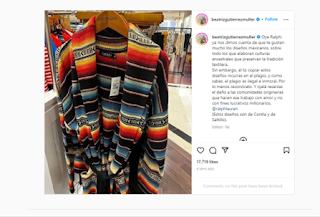
The wife of the Mexican President wrote on Instagram below the photo of the claimed item
“Hey Ralph: we already realized that you really like Mexican designs, especially those that are elaborated by ancestral cultures that preserve textile tradition. However, by copying these designs you incur in plagiarism, and as you know, plagiarism is illegal and immoral. At least acknowledge it. And hopefully you will compensate the damage to the original communities that do this work with love and not for millionaire profit. @ralphlauren (These designs are by Contla and Saltillo.)”
[translation, my own] 

Let’s put our IP hat on: is this plagiarism? Is there an infringement? Traditional cultural expression as such is not protected under the umbrella of IP. Yet, WIPO’s Intergovernmental Committee (IGC) on IP and Genetic Resources, Traditional Knowledge and Folklore is working on an international instrument for their protection. [for the drafts go to this page here). The matter is that IP has a period of protection (full stop). That is the terrible reality that traditional knowledge in general suffers. Added to this, is the fact that even if it were protected by let’s say copyright, there is the argument of ‘inspiration’ that designers rely heavily on. However, there is a fine line between ‘inspiration’ and ‘copy’, and this has been reflected more in recent years (or at least we have become aware of it). 
For instance, three months ago, we brought to you the news of Mexico vs Shein, for a garment deemed to be copied by the latter which contained Mayan’s traditional culture. Two years ago, we also posted about the Guna people in Panama vs Nike which contained a ‘mola’ design. I am sure there is not enough space to tell you all about this situation that seems to happen all over again, and again. 

Back to the news
Ralph Lauren has apologised and noted that months ago they remove it and were surprised to see the final products on display. This may be the end of the story, but not for the communities around the world. While waiting for the WIPO international instruments, there is nothing stopping governments to pass their own national laws protecting their traditional knowledge. Yet, this would be protection on their national territory, I am afraid, but at least, it is something. 

The suspicious link sent here.
Read More

Friday, 11 September 2020

Patricia Covarrubia

Today! Don't forget the 'event' TK and IP

    No comments:

 As noted early on the week under 'upcoming events on this week', today is the day to attend the webinar by the World Intellectual Property Organization (WIPOE-commerce and Intellectual Property for Indigenous Peoples and Local Community Entrepreneurs

I will be in attendance, will you?

The majority, if not all of our countries in Latin America are rich in genetic resources and traditional knowledge. Many do indeed protect traditional handicraft under Geographical Indications and for instance, Panama has a sui generis Law 20 (2020) which aims to protect TK and TCEs.

In Brazil, there are many local products that have benefited from GI protection (as a sui generis system), and some of them were globally seen in the Olympic games Rio 2016 (opening ceremony). Here you can see a very helpful map of GIs in Brazil.

In Colombia, there are 11 Denominations of Origin granted to handicraft, one of them is the weaving products 'Wayuu' referring to the Wayuu indigenous people. Check out (here)  the list of DOs already granted in Colombia. 

For more inside in how TK is seen as economic activity, check out this paper (available here) that I wrote back in March 2019 (IIC). Remember, GI has the potential to benefit rural communities, but there is some instance that there is no gold at the end of the rainbow. 


Read More

Wednesday, 18 September 2019

Patricia Covarrubia

Intangible Cultural Heritage, Intellectual Property and the Politics of Development

    No comments:
The Enredados network (policymakers, academics, and practitioners in the fields of intellectual property (IP) and intangible cultural heritage (ICH)) is pleased to invite you to a seminar and panel discussion.

Intangible Cultural Heritage, Intellectual Property and the Politics of Development
Christoph Antons (University of Newcastle, Australia)

In countries of the “developing world”, intangible cultural heritage is important for both national development policies and the rights claims of local and indigenous communities. All intangible cultural heritage is originally local, but national governments tend to shift it to the national level in the interest of nation building and income from tourism. Where communities have migrated or live across borders drawn by colonial powers, this has triggered disputes between neighbouring countries, whereby governments use different national histories and interpretations of an often mystical past to support heritage claims. Law as an instrument of the state has supported this centralisation of heritage claims and administration in the initial stages.

Image result for christoph antons
Antons' latest edited volume
Recently, however, communities have begun to articulate their own regional and local interests in heritage and are finding some support from constitutional reforms strengthening human rights and supporting decentralisation policies. Such decentralisation policies in turn were triggered by a paradigm change in development policies which aimed at a reduction of what was perceived as central government corruption and at a better sharing of resources with regions and provinces. The presentation will show the bargaining in this context about intangible cultural heritage (and related royalties) between communities, communities and governments and between the governments of neighbouring countries. In claiming what they perceive to be their rights, the parties involved use frequently changing combinations of legal principles with varying degrees of validity and legitimacy, drawn in particular from intellectual property law, international law, environmental law, constitutional law and customary law. The presentation will focus on examples from Southeast Asia, with brief comparative observations related to developments elsewhere.

Place: Coventry University London Campus
Middlesex Street, London, UK
Date: Monday 23 September 2019
Time: 5.30pm-8pm
*FREE ENTRANCE*


Enredados aims to encourage debate on the following issues:

  • the relationship between IP and ICH safeguarding;
  • the intersections between IP and ICH-related policy; and
  • how IP protection might be used as a tool for safeguarding ICH.


See you there.

Read More

Monday, 27 May 2019

Patricia Covarrubia

The Guna people to Nike: Just don't Do It

    No comments:
@Isaac Larrier
A limited edition by sportswear Nike is a trending topic. The shoes were to be a tribute to Puerto Rico but the Guna people, the second largest indigenous community in Panama, objected to the design. The said design was a ‘mola’, which is a protected traditional design by the community. The design in question are the traditional 'mola' patterns which feature colourful, swirling designs and geometric or figurative drawings. This art is ‘passed on stitch by stitch from mothers to daughters and bears witness to the Guna vision of the cosmos and their harmonious relationship with nature’.
Read More

Wednesday, 31 October 2018

Patricia Covarrubia

Traditional Knowledge and YOU!

    No comments:
I am not known as a selfish person, unless I am asked to share a chocolate cake; but looking to the amazing opportunity brought by WIPO I just wanted to keep it to myself!

Huichol's TCE, Mexico
The WIPO Traditional Knowledge Division is advertising an internship for 2019 taken place in Geneva. It is for an initial period of six months, which can be renewable for six months more. The post is addressed to those that have a background in intellectual property (IP) law, and an advanced degree (Master, PhD etc.). Particularly, they are looking for those that have an ‘interest in the relationship between IP and traditional knowledge, genetic resources and/or traditional cultural expressions.’[basically, me!].

For more information, check their web-page here. For you to be eligible, your advance degree should have been granted within a maximum of two y
ears from the completion of the studies [so, not me ;(].
Read More

Thursday, 8 March 2018

Patricia Covarrubia

Genetic Resources and Patent Applications

    No comments:
From the Brazilian Instituto Nacional da Propriedade Industrial (INPI) we became aware that as of the 27th February, 2018, INPI will start to issue formal Official Actions (Official Bulletin Code No. 6.6.1) for all patent applications filed in Brazil covering inventions related to the access to national genetic heritage and/or associated traditional knowledge (TK) - (código de despacho 6.6.1).

This will be automatically issued in all patent applications filed with INPI and so, applicants need to provide proof of registration and / or authorization of access to access to national genetic heritage and/or TK within 60 days of publication in the Revista Eletrônica da Propriedade Industrial (the Brazilian Official Bulletin).The applicant shall produce a Guia de Recolhimento da União (GRU) which is a ‘positive’ declaration to the access to national genetic heritage and/or TK. According to INPI, if the applicant does not provide such proof within 60 days, ‘it will be considered that there was no access to the access to national genetic heritage and/or TK, and INPI will continue the examination of the patent application.’ [wait…INPI will continue? so what is the point?]

INPI also informs that this formality is needed ‘because Law 13,133 / 2015 establishes that, for the purposes of regularization in INPI of patent applications applied for during the validity of Provisional Measure No. 2.186-16 / 2001, the applicant must present the
proof of registration or authorization of access to the national genetic heritage and /or associated TK within one year counted from 06/11/2017.’…does it mean that INPI will continue examining the application but yet will not grant the patent because there is a need to this formality?


I don’t feel supportive of this notification made by INPI. It is like…hello, please submit the proof, if you don’t, then no worries we’re still going ahead with examining your application. This guidance or declaration made by INPI should have been better defined and actually challenging the applicants, e.g. ‘no proof no examination’ (especially in an office that suffers from backlog). Firstly, a company continuing with their application will just want to test the waters with their invention and once they see that they have a chance of being successful, then would look for the proof of registration and / or authorization of access to the national genetic heritage and / or associated TK.

Source INPI.
Read More