Welcome to our blog for Intellectual Property Law and Practice in Latin America!
¡Bienvenidos a nuestro blog de Derecho y Práctica de la Propiedad Intelectual en Latinoamérica!
Bem-vindo ao nosso blog sobre Direito e Prática de Propriedade Intelectual na América Latina!

Tuesday, 10 June 2014

Jeremy

New blog on the block: Ip Lat Am

IP Tango welcomes another Latin American intellectual property law blog. Its name is Ip Lat Am.  According to Pablo A. Palazzi (Allende & Brea, Argentina), Ip Lat Am proposes to blog news, cases and regulations. "For now we only have covered Paraguay, Argentina and Mexico", says Pablo, who is trying to contact local colleagues who may be interested in writing in the blog.  The idea is to try to have the articles written in English or with an English summary. Good luck, Pablo and friends: I hope you have better fortune in securing a good flow of IP information from across the Continent than we have!

Read More
Jeremy

"The Happiest Days of Our Lives": Wall of evidence keeps PINKFLOYD! off Colombian TM register

According to Article 136(e) of Decision 486 of the Andean Community:
“Those signs the use of which in commerce may constitute an impediment to the rights of third parties, may likewise not be registered as trademarks, in particular where:
e) [they] consist of a sign that is capable of affecting the identity or prestige of legal entities, whether non-profit or not, or natural persons other than the applicant or identifiable by the general public as being such a different person, particularly in regard to a given name, family name, signature, title, nickname, pseudonym, image, portrait, or caricature, where no consent has been obtained from that person or, if deceased, the declared heirs of that person ...”
This provision, which is not often invoked, came to the aid of vintage rock group Pink Floyd following an application for registration of the trade mark PINKFLOYD! for agricultural products (Nice Class 31). Pink Floyd (1987) -- the company established by band members David Gilmour and Nicholas Mason -- said it wanted to file an opposition even though it had no trade mark rights which could base an opposition in Colombia. Its only hope therefore was Article 136(e). Evidence of the group's history, sales, musical achievements, events, concerts, press articles, contracts and trad emark registrations in other jurisdictions was filed in order to prove that the band's name enjoyed worldwide recognition and that the members of the company had rights over it. This evidence was accepted by the Colombian Trademark Office, which concluded that the level of recognition of the band name transcended the language barrier and that Pink Floyd was well known by the Colombian consumer public -- even though the meanings of the English terms ‘pink’ and ‘Floyd’ were not common knowledge in the country.

On this basis, the opposition succeeded. The sign applied for and the name in conflict were confusingly similar, since the inclusion of an exclamation mark at the end of the sign was not sufficient to make it distinctive and any consumer could be confused as to the origin of the goods, due to the evident association with the band. Moerover, use of the mark PINKFLOYD! for the goods covered by the application in Class 31 would affect the identity and prestige of Pink Floyd (1987).

Source: "Pink Floyd successfully defends name without prior trademark registration" by Laura Michelsen and Andrés Medina (Triana Uribe & Michelsen, Bogotá), written for World Trademark Review, 10 June 2014

"The Happiest Days of Our Lives", here
Read More

Thursday, 5 June 2014

Rodrigo Ramirez Herrera @ramahr

Nuevo Sistema de Arbitrajes en Línea para dominios .CL de Chile inicia sus operaciones

El registro de nombres de dominio ˂.CL˃, NIC Chile, dio inicio este miércoles 4 de junio al nuevo servicio de arbitraje en línea, que pone a disposición de las partes y de los árbitros para facilitar la tramitación y administración de los conflictos por nombres de dominio ˂.CL˃.
   
La plataforma electrónica fue dada conocer el pasado martes 3 en la Facultad de Ciencias Físicas y Matemáticas de la Universidad de Chile.

La implementación del nuevo servicio de arbitraje en línea forma parte de los cambios consensuados con el Consejo Nacional de Nombres de Dominio y Números IP, quien en el año 2011 apoyó la actualización propuesta por NIC Chile a la reglamentación del registro de nombres de dominio ˂.CL˃ y el procedimiento de resolución de disputas. Al mismo Consejo le cupo posteriormente un rol clave en la selección del nuevo cuerpo arbitral a través de un concurso público.

El nuevo servicio consta de una plataforma electrónica diseñada para facilitar la tramitación y administración de los expedientes arbitrales en un entorno digital seguro. Lo anterior, permite que toda la sustanciación de los conflictos genere un expediente digital, en el cual se tramita y se actúa en forma remota, tanto el juez árbitro como las partes.


Fuente: www.nic.l

 
Read More

Tuesday, 27 May 2014

Patricia Covarrubia

The bread and...tequila: Guanajuato adds value to the region

    No comments:
The Mexican Institute of Industrial Property (IMPI ) informs that its President and the governor of the state of Guanajuato recently met to award two particular collective marks in this region.

A collective mark was given to 'Pan Grande de Acámbaro' for bread producers in the town Acámbaro. By typing these words in the internet search box, I was overwhelmed by the quantity of information. From Wikipedia to a bakery in Chicago we can find interesting data as evidence of this traditional bread. In particular, the Acámbaro governmental web page tells the story of the ‘Art of Making Bread’ noting that while this came from the Old World, the people of Acámbaro started to recreate and perfect the bread (since the 1500s), giving their own expression. Accordingly, it is observed that ‘Pan Grande de Acámbaro’ has a “unique combination of knowledge and art of ancient roots.” The town annually celebrates a bread fair.

The other collective mark that was granted was ‘Tequila Huanímaro Exclusivo Grande’ to farmers of agave. Huanímaro is one of the seven municipalities involved in the production of tequila and yet, this is the first collective mark granted in the region of Guanajuato. It is reported that the mark would benefit over 120 families who “work in more than 800 hectares and have a capacity to daily process thousand litres of tequila”.

Finally, IMPI reports that during 2013 the state of Guanajuato received 3,675 applications to register distinctive signs and that more than 2,835 were successfully registered. IMPI remarks that collective marks “bring added value to what is produced and opens wide possibilities”.
Read More

Friday, 23 May 2014

Patricia Covarrubia

Amazon region vs amazon.com

    No comments:
This week the Government of Peru welcomed the decision of the board of the Internet Corporation for Assigned Names and Numbers Internet Domains (ICANN), which rejected the application for registration of the domain <.amazon>.

As reported last year (here) Peru and Brazil presented an early warning (EW) of rejection of the domain registration <.amazon> applied for by Amazon EU S.à r.l. (subsidiary of ‘Amazon.com Inc.’). The application (ID: 1-1318-83013) for a new generic top level domain (gTLD) was assessed by the board and received an evaluation result as ‘Pass IE’ (initial evaluation report here). However, it is noticeable that at the end of this report there is a disclaimer which indicates that the said IE does not ‘necessarily determine the final result of the application.’

One can observe that the date of the IE is March 2013 by which time ICANN had received (on 20 November 2012) an Early Warning (EW) submission by Peru and Brazil (ID:1-1315-58086 here). In this, the two countries expressed the reason for such an opposition as follows:
• "The Amazon region constitutes an important part of the territory of Bolivia, Brazil, Colombia, Ecuador, Guyana, Peru, Suriname and Venezuela, due to its extensive biodiversity and incalculable natural resources. Granting exclusive rights to this specific gTLD to a private company would prevent the use of this domain for purposes of public interest related to the protection, promotion and awareness raising on issues related to the Amazon biome. It would also hinder the possibility of use of this domain to congregate web pages related to the population inhabiting that geographical region."
• "This gTLD string requested ... matches part of the name, in English, of the “Amazon Cooperation Treaty Organization”, an international organization which coordinates initiatives in the framework of the Amazon."
• "The “.AMAZON” gTLD D has not received support from the governments of the countries in which the Amazon region is located ".
This submission is followed by ICANN explaining that an EW “is a notice only". That said, it continues to explain that it is “not a formal objection, nor does it directly lead to a process that can result in rejection of the application.”

While this proviso appears crystal clear and the whole administrative procedure as such is straightforward, I wonder what is the role of the ICANN in the early stages.I am particularly amaze by the fact that GAC submission was in Nov 2012 and the IE was in March 2013 -i.e. a couple of month to consider this matter. More specifically, ICANN was made aware that Amazon is a region in Latin America [is it just me who was taught this in school? or perhaps you have heard about the Amazon rainforest and/or the Amazon river]. The reservation is: in the IE the board gave the ‘pass’ note to the issue of geographic name.
Geographic Names Not a Geographic Name - PassThe Geographic Names Panel has determined that your application does not fall within the criteria for a geographic name contained in the Applicant Guidebook Section 2.2.1.4."
Isn't this peculiar? Am I missing something? Or is it just me who seems to recognise Amazon as a region and not just where I purchase products on-line.


Read More

Wednesday, 21 May 2014

Patricia Covarrubia

Chile: promoting and protecting local development

    No comments:
During May we notice the force of the Chilean program ‘Origin Mark’ (Sello de Origen). The program has been developed by the Ministry of Economy together with INAPI --aiming to promote and protect typical products and thus, endorse local development.

Denomination of Origin (DO)
In Chile, DO “identifies a good as originating in the country , region or locality of the country, when its quality , reputation or other characteristic it is essentially attributable to its geographical origin , taking into account especially the natural and human factors that mark the characterization of the product.

On May 8th two products were postulated to be recognised with this system i.e. DO:
1.- Bordados(embroidery) Isla Negra
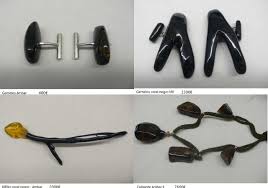
Textiles and textile products created by the farmers’ and fishermen’s women who have become internationally known artists and their achievements have marked a milestone in Latin American art.
2.-Artesanias (crafts) in Coral Juan Fernandez
Craft produced with black coral Juan Fernandez which is located between 100 and 300 meters deep in the sea.

Both applications have been processed at INAPI and if granted, it is “expected to contribute to the rescue of local culture, increase the demand for these products and encourage the establishment of new tourist routes in these regions. “

Geographical Indication (GI)
GI refers to “the place or region of production, mining, farming or processing, which determines the specific qualities of the product from that place or region. Recognition should be credited for their reputation, quality or any relevant product characteristic attributable to their place of cultivation, extraction or production. Therefore, there must be a specific ‘link’ between the products and their original place of production, which is reflected in the name by which the product stands.”

On Monday May 12th INAPI received an application for GI for the agricultural product 'Aceitunas (olives) Azapa Valley', prepared in four different ways, as traditional practices of the particular area of the country .

The president of the Association of olive growers attended accompanied by other member from different institutions and associations. Moreover, the application was sponsored by the Foundation ‘Hacer Chile’ (Make Chile) and a social entrepreneur, who have collaborated with the Association of Olivocultores Azapa Valley to organize and raise this request for recognition.

If accepted, these three applications together with the recently submitted for watermelons (previous post here) will join Limón de Pica (lemon), Atún de Isla de Pascua (tuna), cangrejo Dorado de Juan Fernández (crab), Sal de Cachuil-Boyeruca-Lo Valdivia (salt), Alfarería de Pomaire (pottery) and, Dulces de la Ligua (sweets).

Source INAPI ( here for the DOs and here for the GI).
Read More

Tuesday, 20 May 2014

Jeremy

CHAMPAGNE for bleach? Not in Chile!

Chile's Industrial Property Court has reversed a first instance decision issued by the National Institute of Industrial Property (INAPI) relating to the registration of the word CHAMPAGNE as a trade mark for goods in Class 3. INAPI initially rejected the application for only some of the goods covered; the court however rejected the application in its entirety.  Rodrigo Cooper applied as long ago as 2008 to register the word CHAMPAGNE for various goods in Class 3. The Comité Interprofessionnel du Vin de Champagne opposed, claiming that the application violated Articles 19, 20(e), (f) and (j) of the Industrial Property Law (Law 19.039), Article 10 of the Paris Convention and Articles 22 et seq. of TRIPS. Said the Comité, “Champagne” was a famous appellation of origin and its use for other products would create confusion in the market. No, said Cooper: “Champagne” was unrelated to products in Class 3, so there would pose no risk of confusion of consumers.

In April 2012 INAPI rejected the opposition based on Articles 20(e) and (j) of the Industrial Property Law, since protection the appellation of origin CHAMPAGNE only applied to products in Class 33. The opposition was upheld for “soaps, essential oils, cosmetics and hair lotions” based on Article 20(f), where there was a risk of confusion, but rejected for “bleaching preparations and other substances for laundry preparations for cleaning,” among other products.

The Comité appealed to the Industrial Property Court which, in September 2013, allowed the appeal and refused the trade mark for all products in Class 3. Since the term “Champagne” corresponded to a famous appellation of origin, it could not be used or registered in Chile by anyone who was not a producer of that type of wine in France. Moreover, acceptance of the mark would induce consumers to believe that products bearing that mark were originally from the French region of Champagne.

Source: INTA Bulletin, May 1, 2014 Vol. 69 No. 9
Read More

Monday, 19 May 2014

Jeremy

Brazil launches Phase 3 of its Green Patent Programme

Last month, on 29 April, just 14 months after Patricia Covarrubia posted this piece on the grant of Brazil's first green patent, the Instituto Nacional da Propriedade Industrial (INPI) published Resolution 131. This expands the priority examination of green patent applications to its third phase. In this new phase of the programme -- which expires on 16 April 2015 or when the figure of 500 new requests has been reacehd -- patent applications filed under the Patent Cooperation Treaty (PCT) are also being taken into account.

Patent applications that qualify for this programme will be checked by an INPI technical board.  Only applications relating to certain types of technology will be considered, eg alternative energy, transport, energy conservation, waste management and agriculture (a full list of qualifying technologies can be read here).

There's more to it than merely falling within a category of technology that qualifies for fast-tracking, of course. Thus (i) the patent or utility model application must have up to 15 claims of which (for patent applications) up to three may be independent claims and (ii) there must be a Brazilian application, a PCT application in the Brazilian national phase or a Brazilian application filed under the Paris Convention [is there any other route to patent protection in Brazil apart from these?].

The Green Patent Programme, in force since 2012, has now attracted 523 requests, of which only 11 have been rejected.So far, 19 patents have been granted under the programme, each taking an average examination time of 385 days.

Source: Di Blasi Parente & Associados email circular here (in English and Portuguese)
Read More
Patricia Covarrubia

Tequila: arriba! arriba!

    No comments:
ARRIBA MÉXICOFrom Mexico we hear news regarding the Denomination of Origin (DO) ‘tequila’ and the highlights of a well-known and reputable product. In this line, the Tequila Regulatory Council (CRT) presented awards to the World Intellectual Property Organization (WIPO) and the Mexican Institute of Industrial Property (IMPI) by the work shown by both institutions concerning the protection of IPRs and geographical indications (GIs). WIPO received the highest award i.e. ‘Eagle in Flight’.

The CRT’s director, Mr Ramón González Figueroa, explains that their “successes are the result of joint work with [Mexican] government and the World Intellectual Property Organization (WIPO)”. Ever since 1974 tequila has been recognized as a DO in Mexico and is protected in 45 countries. It was registered at international level (under the Lisbon Agreement) in 1978.

Achievement in international markets.
Tequila is describe as a ‘unique cultural product’ due to its source i.e. fermented from the indigenous plant blue agave. Currently there are 160 companies producing Tequila (duly certified by the CRT) with an average export of 165 million litres. Tequila has a presence in over 120 countries and there are over 1,350 active trade marks.

Source IMPI.
Read More

Tuesday, 13 May 2014

Patricia Covarrubia

Ecuador: 2014 Year of the Denomination of Origin

    No comments:
As a part of its strategy to promote Ecuadorian products through better information of the consumers, the Ecuadorian Institute of Intellectual Property (IEPI) has declared 2014 “Year of the Denomination of Origin”. As a result, producers who want to apply to get logos aimed at identifying Ecuadorian Denominations of Origin (DO) have a 100 percent discount on the procedure.


The announcement was released on April 21 in Vinces, province of Los Ríos, renowned for its high quality cocoa production. During the launch event, three new logos also made their debut: “Ecuador” (general logo), “Cacao Arriba – Ecuador” (for cacao) and “Montecristi – Ecuador” (for hats).


The entire initiative promoted by the governmental organization has the objective to raise awareness regarding the potential benefits of the DO regime for those producers interested in highlighting the importance of the link between their products and the area of production.

More information (in Spanish)here.

Post written by Nicola Coppola, University of Bournemouth.
Read More