Welcome to our blog for Intellectual Property Law and Practice in Latin America!
¡Bienvenidos a nuestro blog de Derecho y Práctica de la Propiedad Intelectual en Latinoamérica!
Bem-vindo ao nosso blog sobre Direito e Prática de Propriedade Intelectual na América Latina!
Showing posts with label Mexico. Show all posts

Thursday, 27 October 2022

Patricia Covarrubia

Mexico: Plagiarism and traditional cultural expression

    No comments:
I received an email yesterday morning with a link to the BBC Latin America News. I am always skeptical to open links due to virus (are you not?). On second thoughts, I read the link and it was clear that was a verified page and when I clicked there were some juice news for our blog 😊 The heading reads: “Ralph Lauren apologises after Mexico indigenous 'plagiarism' claim”. My reaction was, not again! It has become usual to see big business appropriating cultural designs. But I wonder whether this is due to social media and we, as a society, are more aware of it. The era of globalization surely has made us more aware of what is going on in every corner, but also may have brought in us an appetite for merchandise that is only available in certain regions, or cultures [would you agree?]. 

Back to the news. 
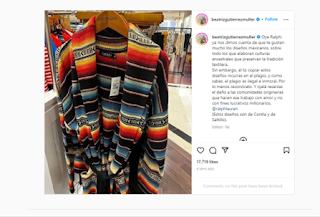
The wife of the Mexican President wrote on Instagram below the photo of the claimed item
“Hey Ralph: we already realized that you really like Mexican designs, especially those that are elaborated by ancestral cultures that preserve textile tradition. However, by copying these designs you incur in plagiarism, and as you know, plagiarism is illegal and immoral. At least acknowledge it. And hopefully you will compensate the damage to the original communities that do this work with love and not for millionaire profit. @ralphlauren (These designs are by Contla and Saltillo.)”
[translation, my own] 

Let’s put our IP hat on: is this plagiarism? Is there an infringement? Traditional cultural expression as such is not protected under the umbrella of IP. Yet, WIPO’s Intergovernmental Committee (IGC) on IP and Genetic Resources, Traditional Knowledge and Folklore is working on an international instrument for their protection. [for the drafts go to this page here). The matter is that IP has a period of protection (full stop). That is the terrible reality that traditional knowledge in general suffers. Added to this, is the fact that even if it were protected by let’s say copyright, there is the argument of ‘inspiration’ that designers rely heavily on. However, there is a fine line between ‘inspiration’ and ‘copy’, and this has been reflected more in recent years (or at least we have become aware of it). 
For instance, three months ago, we brought to you the news of Mexico vs Shein, for a garment deemed to be copied by the latter which contained Mayan’s traditional culture. Two years ago, we also posted about the Guna people in Panama vs Nike which contained a ‘mola’ design. I am sure there is not enough space to tell you all about this situation that seems to happen all over again, and again. 

Back to the news
Ralph Lauren has apologised and noted that months ago they remove it and were surprised to see the final products on display. This may be the end of the story, but not for the communities around the world. While waiting for the WIPO international instruments, there is nothing stopping governments to pass their own national laws protecting their traditional knowledge. Yet, this would be protection on their national territory, I am afraid, but at least, it is something. 

The suspicious link sent here.
Read More

Friday, 29 July 2022

Patricia Covarrubia

Mexico: cultural (mis) appropriation

    No comments:
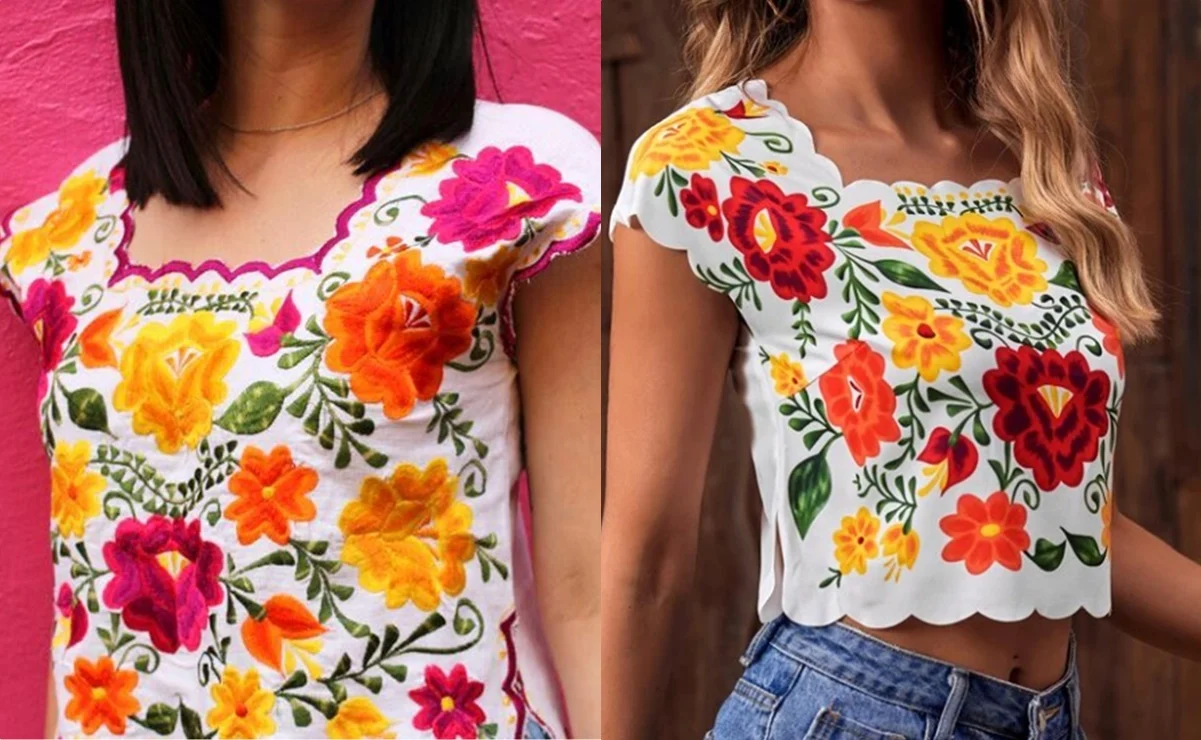
Last week, the Mexican Secretary of Culture sent a letter to the company SHEIN asking to clarify the launch of the piece “Flower trim top with floral print” that is identical to a garment designed by the handicraft brand ‘ YucaChulas’.

The statement reads ‘” cultural elements whose origin is fully documented’, which generate economic rewards in the communities that sell them. The blouse, short huipil, was created in the Mayan communities of Yucatan, Campeche and Quintana Roo, and its design would not be possible without knowledge “transmitted from generation to generation, product of the collective creativity of the Mayan people.”’ YucaChulas also went to social media (here) to express their dismay against SHEIN due to the lack of recognition of the work made by local artisans and how plagiarism diminish and devalued their culture. Since then, SHEIN has removed the garment and noted in a statement that it was not their intention ‘to infringe anyone’s valid intellectual property and it is not our business model to do so.’

Photo: El Universal - YucaChulas left; SHEIN to the right


As you know, the protection of cultural expression through intellectual property is a heated debate. And now, WIPO has advanced in this topic – see early publication here. In the meantime, some countries, especially in Latin America, have some kind of legislation that regulates the use of traditional knowledge, but yet there is not clear procedure or enforcement, it seems like just ‘good practice’. However, one must say that the Panama Law No. 20 on the Special Intellectual Property Regime with Respect to the Collective Rights of Indigenous Peoples to the Protection and Defence of their Cultural Identity and Traditional Knowledge, seems a solid one. Others, like Colombia, continues to use Geographical Indications protecting cultural expressions and traditional knowledge, although this protects the product linked to the origin, rather than the product per se. The same strategy is used in Peru, where you will notice several ‘collective marks’. Yet, IP is territorial and these legal tools, used in Panama, Colombia and Peru as examples, only will stop the ‘plagiarised’ product to be sold in their countries, but can continue to sell it in other jurisdictions. [sad]

Read the news at El Universal MX
Read More

Sunday, 6 February 2022

Verónica Rodríguez Arguijo

Tequila: finaliza la investigación bajo el Reglamento sobre obstáculos al comercio (TBR) de la UE


El 3 de febrero de 2022, la Comisión Europea anunció que finalizó formalmente su investigación sobre la denuncia referente a obstáculos al comercio en el sentido del Reglamento (UE) 2015/1843 (Reglamento sobre obstáculos al comercio, TBR en inglés) aplicados por México y consistentes en medidas que afectan la importación del Tequila. Consulta el anuncio aquí.

La denuncia

La denuncia había sido presentada por la Asociación de Cerveceros de Europa (The Brewers of Europe) debido a la decisión del Consejo Regulador del Tequila (CRT) de “ya no [conceder] certificados de exportación a … [TdS, una empresa] que produce y exporta «Tequila» …  [a una] filial de Heineken NV … [debido a que] la cerveza Desperados de Heineken (una cerveza con aroma de «Tequila» añadido) infringe la [Norma Oficial Mexicana] aplicable a la utilización de la Indicación Geográfica (IG)” Tequila.

Durante la primera etapa de la investigación de la Comisión, intervinieron 22 partes interesadas, “en su mayoría representantes de asociaciones velando por la protección de las indicaciones geográficas europeas”. En efecto, oriGIn solicitó a la Comisión el reconocimiento como parte interesada considerando las implicaciones de la disputa en cuanto a los principios de las IG.

De igual manera, el procedimiento de examen también fue discutido por el Parlamento Europeo (lea aquí la pregunta parlamentaria planteada a la Comisión Europa, y consulte aquí la respuesta, ambas en inglés).

En mayo de 2021, la Comisión Europea finalizó el procedimiento de examen de la medida aplicada por México que afecta las exportaciones del Tequila a la UE (consulta el reporte aquí). Se concluyó “que si bien la medida plantea preocupaciones sobre el cumplimiento de México respecto de las normas de la OMC, específicamente la prohibición de restricciones a la exportación, está sujeta a una serie de procedimientos administrativos pendientes que pueden conducir a la revocación o modificación de la medida. Por lo tanto, la Comisión continuará monitoreando el resultado de los distintos procedimientos y, dependiendo de su resultado, podrá reevaluar las acciones a emprender” (énfasis añadido).

En octubre de 2021, la Asociación de Cerveceros de Europa informó a la Comisión Europea que “la empresa de la UE afectada había encontrado una solución con las autoridades mexicanas, lo que permitió la eliminación de los supuestos obstáculos al comercio”. En consecuencia, retiraron la denuncia.

*El 7 de febrero de 2022, se publicó en el Diario Oficial de la Unión Europea, la Decisión de Ejecución (UE) 2022/161 de la Comisión de 3 de febrero de 2022 por la que se da por concluido el procedimiento de examen relativo a los obstáculos al comercio, en el sentido del Reglamento (UE) 2015/1843, aplicados por los Estados Unidos Mexicanos y consistentes en medidas que afectan a la importación de Tequila. Consulta aquí la Decisión de Ejecución. 

El retiro de la denuncia y la finalización de la investigación por parte de la Comisión Europea suceden al acuerdo amistoso entre CRT y Heineken, luego de que CRT iniciara varias acciones legales en la Unión Europea que involucraban el uso de la palabra Tequila en la cerveza Desperados. Consulta aquí mi reporte sobre el acuerdo amistoso al que llegaron las partes.

Créditos:
La imagen es cortesía de Dante Gbn.

*Artículo actualizado el 7 de febrero de 2022.
Read More

Wednesday, 3 March 2021

IPTango

México: Premio IMPI a la invención mexicana 2021


El Instituto Mexicano de la Propiedad Industrial (IMPI) publicó la convocatoria del Premio IMPI a la invención mexicana 2021. 

Podrán participar en la convocatoria personas de nacionalidad mexicana dedicadas a la invención (sin afiliación) o que pertenezcan a una institución pública o privada de educación media superior o superior; centro de investigación; o micro, pequeña y mediana empresa ubicada en México.

Asimismo, los participantes deberán contar con un título de patente, modelo de utilidad o diseño industrial, otorgado de enero de 2019 a 2021 o con una solicitud de patente, modelo de utilidad o diseño industrial presentada ante el IMPI a la que se le haya notificado que procede su otorgamiento (oficio de cita a pago).

Se otorgará un premio en cada una de las siguientes categorías:

  1. Patente
  2. Modelo de utilidad
  3. Diseño industrial
  4. Innovación para micro, pequeñas y medianas empresas (patente, modelo de utilidad o diseño industrial)

Los premios serán entregados en el marco de día mundial de la propiedad intelectual. La fecha límite para participar es el 19 de marzo de 2021.

Las bases de la convocatoria pueden consultarse aquí.

Fuente: sitio web del IMPI, consultado el 3 de marzo de 2021.

Imagen de Gerd Altmann en Pixabay.
Read More

Monday, 28 December 2020

IPTango

In memory of Armando Manzanero


The IPTango team mourns the passing of Armando Manzanero, Mexican songwriter, pianist, singer, producer, and arranger. 

Worldwide famous by his romantic songs, Armando Manzanero, passed away on 28 December 2020. 

Armando Manzanero Canché born on 7 December 1935 in the city of Mérida, Yucatán. 

Considered one of the most renowned composers worldwide, he wrote over 600 songs. Out of these, more than 50 enjoyed global recognition and were performed in more than 30 languages. 

“Contigo Aprendí”, “No Sé Tú”, “Esta Tarde Vi Llover”, “Somos novios”, “Te extraño”, “Adoro”, “Voy a apagar la luz”, “Como yo te amé”, “Por debajo de la mesa”, “Nos hizo falta tiempo”, and “Mía” are some of his most famous songs. 

Among others, Frank Sinatra, Elvis Presley, Luis Miguel, Juan Gabriel, Elis Regina, Andrea Bocelli, Eugenia León, Tania Libertad, Tony Bennett and Alejandro Sanz performed his songs. 

Armando Manzanero was a strong advocate of copyright enforcement. Since 2011, he was the president of the collective management society SACM (Society of Authors and Composers of Mexico). 

Proud of his roots, he sang in Maya during a concert held in Chichen-Itzá to celebrate his 83-year career.

Armando Manzanero received several awards, including the Latin Grammy Lifetime Achievement Award (2010), the Grammy Lifetime Achievement Award (2014), and the Cultural Heritage of the Americas Award granted by the Organization of American States (2014). 

In October 2020, Armando Manzanero received the Billboard Lifetime Achievement Award “for his exceptional career that spans over six decades and which has taken Latin music to the next level internationally”. 

The Secretariat of Culture of Mexico will pay tribute to Armando Manzanero through Canal 22, Radio Educación, and the online platform “Contigo en la Distancia”. 

As stated on the SACM website: “His legacy is recorded in the history of music for Mexico’s glory in the world”. 

Listen to Armando Manzanero here and here. 


Sources: 
· Biography of Armando Manzanero published on the SACM website. 
· The review published on the website Celebrando Armando Manzanero. 
· The article “Armando Manzanero to Receive Lifetime Achievement Award at 2020 Billboard Latin Music Awards” published on the Billboard website. 

Credit: Image available on the website of the Secretariat of Culture of Mexico, accessed on 28 December 2020.
Read More

Saturday, 26 December 2020

IPTango

Mexico: the USPTO and IMPI launched the Parallel Patent Grant (PPG) initiative


On 7 December 2020, the Mexican Institute of Industrial Property (IMPI) and the United States Patent and Trademark Office (USPTO) announced the launch of the Parallel Patent Grant (PPG) initiative. 

According to the press releases, the PPG results from the Memorandum of Understanding on Technical and Strategic Collaboration (MoU) signed by the USPTO and IMPI on 28 January 2020. 

In accordance with the MoU, the two Offices would “implement a parallel patent grant framework that allows IMPI to leverage USPTO search and examination results when granting a counterpart Mexican patent”. 

Thus, under the PPG, “IMPI will expedite the grant of a Mexican patent for businesses and individuals already granted a corresponding U.S. patent”. This worksharing arrangement will make “faster for U.S. patent holders to obtain corresponding patents in Mexico”. 

As stated by IMPI, approximately 11,000 patent applications filed between 2015 and 2018 may benefit from the PPG. 

The PPG is not the first worksharing collaboration between IMPI and the USPTO, given the Patent Prosecution Highway (PPH) program has been implemented since 2011. 


Credit: Image by Guy Dugas from Pixabay.
Read More

Friday, 9 October 2020

IPTango

En memoria de Hugo Contreras Lamadrid, Director General del Instituto Nacional del Derecho de Autor


El equipo de IPTango se une a la pena que embarga a familiares, amigos y colaboradores por el fallecimiento de Hugo Contreras Lamadrid, Director General del Instituto Nacional del Derecho de Autor (INDAUTOR).

El Profesor Gustavo Schötz comparte con nuestros lectores una semblanza sobre Hugo Contreras Lamadrid:

De modo sorpresivo, a sus 54 años, falleció Hugo Contreras Lamadrid. 

Se graduó como Licenciado en Derecho por la Universidad Nacional Autónoma de México (UNAM). Contaba estudios de Maestría y una Especialidad en Derecho de la Propiedad Intelectual por la División de Posgrado de la Facultad de Derecho de la UNAM y una especialidad en Derecho Civil por la Universidad Panamericana. 

Fue Director del Seminario de Derecho Procesal de la UNAM, donde fue distinguido con la Cátedra Extraordinaria “José Castillo Larrañaga”.

Desde 2018 fue el Director General del Instituto Nacional del Derecho de Autor (INDAUTOR). Fue Representante de México en el Comité Permanente de Derecho de Autor y Derechos Conexos (SCCR) de la OMPI. 

Entre 2012 y 2014 fue co-fundador y Director de la Revista Derecho sin Fronteras, publicación jurídica sobre derecho constitucional, procesal, propiedad intelectual, derecho sanitario y derecho penal.

Fue Profesor Invitado de la Universidad de Buenos Aires, la Universidad del Salvador y la Universidad Austral, de Argentina. 

Se especializó en la resolución alternativa de conflictos, especialmente la mediación, y abogaba para una más extensa aplicación de esta figura para resolver los conflictos vinculados al derecho de autor. 

En lo personal, fue un gran amigo y colega. Nos conocimos hace 10 años, con ocasión de un seminario conjunto entre la UNAM y la Universidad Austral sobre patentes en biotecnología y datos de prueba en biosimilares, en Buenos Aires. Compartimos la organización y exposición en varios cursos y programas de televisión, ya que fue productor de Derecho sin Fronteras en el canal de la UNAM. En 2012, se incorporó al Consejo de Redacción de la Revista Iberoamericana de la Propiedad Intelectual (RIPI).

Luego vino su nombramiento en el INDAUTOR y coincidimos en el SCCR de la OMPI, donde impulsamos distintas iniciativas, siempre en el marco del GRULAC. Fue un gusto y un honor compartir esos momentos con Hugo. 

Siempre fue muy trabajador y dedicado. Apasionado docente. Se podía hablar con confianza y tenía posiciones muy constructivas. 

Conocimos a su familia, Inés y sus hijos, con quienes compartimos la aflicción que los embarga. Para Hugo, la familia siempre estaba en el primer lugar de sus conversaciones. 

Te extrañaremos Hugo.


Crédito: Imagen disponible en la página web de la Secretaría de Cultura del Gobierno de México, consultada el 9 de octubre de 2020.

Read More

Thursday, 13 August 2020

Verónica Rodríguez Arguijo

Reminder: today is the deadline to submit your application for the National Patent Drafting Workshop


As it was announced here, the World Intellectual Property Organization (WIPO) and the Mexican Institute of Industrial Property (IMPI) will hold the National Patent Drafting Workshop from 17 to 21 August 2020. 

The online workshop is addressed to researchers and academics of universities, technology transfer and research centres. 

The course aims to foster innovation by improving the skills of patent applicants. The free workshop is limited to 80 participants.

Today is the deadline to submit your application here. Likewise, the universities or centres must send an email to impi.eventos5@impi.gob.mx to endorse the submissions. 

More information here. 


Image of Gerd Altmann on Pixabay.
Read More

Thursday, 5 December 2019

Gilberto Macias (@gmaciasb)

México – Ley de Salvaguardia contra plagio a Culturas Indígenas y Afromexicanas

El principal objetivo de la denominada Ley de Salvaguardia de los Conocimientos, Cultura e Identidad de los Pueblos y Comunidades Indígenas y Afromexicanos es evitar el plagio de obras, artesanías, prendas típicas, artículos, entre otros, y garantizar su cultura e identidad nacional.

Según el Dictamen de las Comisiones "la salvaguardia se entiende como el conjunto de medidas de carácter jurídico, técnico, administrativo y financiero para la preservación y enriquecimiento de los elementos de la cultura e identidad de los pueblos y comunidades (...) que incluyen, entre otras acciones, la identificación, documentación, investigación, protección, promoción, valorización, transmisión y revitalización de esos elementos".

La iniciativa surgió en respuesta a la “laguna jurídica” que existe y facilita que personas ajenas a las comunidades indígenas y afromexicanas se apropien de las expresiones culturales de dichos grupos sin hacer ninguna retribución a cambio. Entre 2012 y 2019, se registraron 39 casos de plagio de al menos 23 marcas de ropa nacionales e internacionales que se han apropiado de diseños de comunidades indígenas.

Read More

Wednesday, 6 November 2019

Gilberto Macias (@gmaciasb)

Impacto económico de las marcas en América Latina


ASIPI e INTA acaban de publicar el informe “Las marcas en América Latina: Estudio de su impacto económico en 10 países de la región”. Este informe es una extensión del informe previamente publicado en el 2016.

En ese primer informe, se evaluó la contribución económica de las industrias intensivas en marcas en Chile, Colombia, Perú, Panamá, y México. En este nuevo informe, se actualizan los resultados de los citados países y se extendió el análisis a cinco nuevos países: Argentina, Brasil, Costa Rica, Guatemala y República Dominicana.

Read More

Tuesday, 6 November 2018

Patricia Covarrubia

Free trade mark databases – the presence of Latin American countries

    No comments:
Have you heard of TMview? This is a common online trade mark information platform. The platform, a free of charge tool, makes trade mark data (registration and application) widely available and easily accessible to all interested parties. The platform is used in the EU and in the ASEAN region.

Talking about views..this is my view!
from the 19th floor of the Korean
 Intellectual Property Office (KIPO)
The European Union Intellectual Property Office (EUIPO) in the EU administers the platform. It has operated since April 2010 and contains information from all of the EU national IP offices, the European Intellectual Property Office (EUIPO) and a number of international partner offices outside the EU.

In Latin America, Mexico was the first country to participate, followed by Brazil, Colombia and in October 2017, Peru. These national IPOs made its trade mark data available to the TMview search tool.

Aside from TMview, there is also DesignView which operates as TMview, i.e., a platform that share data for industrial designs (application and registration) – Peru participates in this platform.

The new participant is Costa Rica, joining both the TMview and DesignView and so, it has now made available its trade mark (278,627 of them) and industrial design (1,700) data available to the EUIPO search tools. The number of trade marks in TMview is close to reach 50 millions (as of 06 November 2018).

Source EUIPO.
Read More

Tuesday, 30 October 2018

Patricia Covarrubia

Universities, Patents and Intellectual Property: do they match?

    No comments:
The Director of the Mexican Institute of Industrial Property (IMPI) reports that the Universidad Nacional Autónoma de México (UNAM), in Mexico City, is the Higher Education establishment that has filed the most patent applications during the period 2013-2018 (278 of them). Therefore, this month IMPI and UNAM signed a collaboration agreement on industrial property.
According to IMPI’s director, IMPI and UNAM share the same ‘commitment to support and promote entrepreneurship and the creation of innovation, as well as the promotion of the predominant role of industrial property, endorsing the protection and commercialization of intangibles.’

In the same line, IMPI notes that since 2012 has increased the Patent Centres (CePats) from 21 to 104. These centres, linked to IMPI, are entities that rise in the research and higher education institutions. They provide consultancies, updates, training in the field of technological information searches, patents, industrial designs, utility models and everything related to the protection of industrial property.

An interesting fact published by IMPI is the data regarding the number of patent applications filed by national Higher Education institutions which, added together, are 1,205 patent applications:
UNAM, 'the people to the university, the university to the people'
 by David Alfaro Siqueiros 

  • The UNAM, 278;
  • the Instituto Politécnico Nacional (IPN), 222;
  • the Benemérita Universidad Autónoma de Puebla, 164;
  • the Universidad Autónoma de Nuevo León, 140;
  • the Instituto Tecnológico de Monterrey (ITESM), 89;
  • the Secretaria de Educacion Publica-Technological National Education of Mexico, 81;
  • the Universidad de Guanajuato, 66;
  • the Universidad de Sonora, 64;
  • the Universidad Autonoma de Querétaro, 56; and
  • the Universidad Autonoma Metropolitana, 45.
Looking at this cooperation we can finally say that the academia and IP are counterparts, working together towards promoting innovation.
Read More

Wednesday, 13 June 2018

Verónica Rodríguez Arguijo

Mexican GIs and the registry of foreign GIs and AOs


This post was first published on The IPKat blog:

Recently, the Mexican Industrial Property Law was significantly amended and on 27 April 2018, the first batch of amendments to the Law entered into force. These amendments modified provisions regarding patents, designs, utility models, trademarks and appellations of origin (AOs). Moreover, for the first time, geographical indications (GIs) are regulated under the Mexican Industrial Property Law and a registry of foreign GIs and AOs lodged the Mexican Institute of Industrial Property will be created.

In this post, this Kat summarizes the amendments that came into force on 27 April 2018, particularly with respect to GIs and AOs. More details about the amendments to the provisions related to industrial designs, patents, and utility models, as previously discussed by Kat friends, can be seen here.

A post by this Kat regarding the second batch of amendments, which will enter into force on 10 August 2018 and were published on 18 May 2018 in the Federal Official Gazette (DOF), will follow!
Read More

Monday, 21 May 2018

Gilberto Macias (@gmaciasb)

México – Reformas a la Ley de la Propiedad Industrial en materia de Marcas.


El pasado 18 de mayo se publicaron en el Diario Oficial de la Federación las Reformas y Adiciones a la Ley de la Propiedad Industrial, en materia de marcas.

En primer lugar, resulta destacable que se extiende la definición de marca, la cual, como en otras legislaciones, queda ahora definida como:

“todo signo perceptible por los sentidos y susceptible de representarse de manera que permita determinar el objeto claro y preciso de la protección, que distinga productos o servicios de otros de su misma especie o clase en el mercado”.

Con este cambio, la legislación mexicana permitirá ahora la protección de marcas no tradicionales, dado que una marca puede estar conformada por denominaciones, letras, números, elementos figurativos y combinaciones de colores, así como por signos holográficos y formas tridimensionales.

Con la reforma, también se reconoce la distintividad adquirida o “secondary meaning”, es decir, se podrán registrar marcas que en principio no son registrables, por considerarse descriptivas o carentes de distintividad, cuando se demostrase su uso previo y efectivo en el comercio.

La reforma incorpora la figura del trade dress, es decir, se contempla ahora el registro como marca de elementos de imagen, tamaño, diseño, color, disposición de la forma, etiqueta, empaque, la decoración o cualquier otro que, al combinarse, distinga productos o servicios en el mercado.

En lo que respecta a la protección de Marcas Notoriamente Conocidas y Famosas, se elimina el requisito de que éstas se encuentren previamente registradas; además de que se establece como causal de nulidad de un registro de marca, cuando éste se haya obtenido de mala fe.

Otra importante reforma es la incorporación de las marcas de certificación, las cuales desde ahora podrán protegerse para distinguir productos y servicios con ciertas cualidades y reglas de uso establecidas, con el fin de agregar mayor valor a la marca y generar más productos y servicios de calidad.

Con esta nueva reforma, una marca puede ser caducada cuando la misma no haya sido objeto de uso por un periodo de 3 años consecutivos. Para evitar la caducidad, se tendrá que presentar una declaración de uso. 

El texto completo de las reformas puede consultarse aquí.
Read More

Friday, 2 March 2018

Patricia Covarrubia

Mexico: it’s all about the cheese!

    No comments:
Since May 2016 the EU and Mexico are trying to modernize the trade agreement between them. By January 2018, there has been eight round of talks/negotiations.

On of the key issues that we see in the negotiation is Geographical Indications (GI). There is no possibility of registering foreign GI in Mexico although Appellations of Origins (AO) are feasible. Therefore, if a foreign company would like to protect their GI it can do so by the multilateral international registration i.e. Lisbon Agreement (Mexico is a member). The other route was by the bilateral agreement but this is limited to spirits and yet again only for AO. A foreign company could also register its GI as a ‘collective trade mark’.

The GI table of negotiation
There are in excess of 330 EU products in the list of negotiation, and this includes the sensitive product cheese. This is so because Mexico’s dairy industry produces many cheeses which names, or better say, GI names, originate from EU terroir.

On one hand, the EU claims their exclusive right to use such names, while on the other, Mexico claims that they have the right to keep producing such products. This is based on the fact that the names have become either generic or even acknowledging a different cheese that has become very much a national product and yet using a GI name. An example in mind would be the ‘Queso Manchego’, a cheese product coming from La Mancha region, Spain. According to its Dossier No ES/PDO/0117/0087 and the EU Commission implementing Regulation No 129/2012 of 13 February 2012, ‘Queso Manchego’ is “[p]ressed cheese made from milk of ewes of the ‘Manchega’ breed, aged for a minimum of 30 days for cheeses weighing up to 1, 5 kg and from 60 days up to a maximum of 2 years for larger cheeses.” The Mexican version is made from cow’s milk and so, the Mexican counterparts claim that the Manchego cheese “is ingrained in local culture and does not even resemble the Spanish original.” Moreover, the head of the National Chamber of Dairy Industries claims that “people identify it as a very national product that isn’t even related to the European version”; “people don’t expect a Spanish Manchego when they go to the supermarket and ask for a Manchego.”

Say 'Cheese'.
Next meeting would be in Brussels. The EU sees the latest talks as ‘very good’. Table of negotiations already closed are: competition, SMEs, transparency, sanitary issues, good regulatory practices, and trade and sustainable development. Pending are: market access and rules, including geographical indications and investment protection. The EU is Mexico’s third trading partner. Since 2000, the EU and Mexico trade in goods has increased by 180% which amounted to €53 billion in 2015. (source: here)

The proposed chapter on IP by the EU is available here.
Read More

Tuesday, 27 February 2018

Patricia Covarrubia

Patent Support Program: Arriva Mexico!

    No comments:
In developing an IP culture, Mexico is launching a ‘support program’. The idea is to assist inventors whose inventions may be capable of IP protection. To do so, the national IP office, IMPI, has united forces with the Mexico-United States Foundation for Science (FUMEC) and Nacional Financiera (NAFIN).

In general, it is highly noted that IP protection may contribute to the commercial activity in Mexico as well as its competitiveness in the collaboration with other countries. Therefore, the aim is to increase the number of patent applications and utility models and thus, adding value to the knowledge of inventors and entrepreneurs in Mexico.

Diving in (Mexico great sport)...to the project...yas!
With immediate effect the 2018 Call for he Patent Support Program is open (and valid until October this year).

What is this project about?
According to IMPI, the support offered ‘consists in providing specialized and free advice to Mexican developers’. It is directed at ‘entrepreneurs, independent inventors, researchers and entrepreneurs in the country, in order to provide them with tools for the protection of their inventions, their use and exploitation exclusively according to the Mexican legal framework.’

How does it work?
The services offered are:
• patentability analysis: examining the state of the art,
• advice regarding the writing of the application,
• delivery of workshops, among others.

It is open to the vast majority of sectors including IT, health, agriculture, environment, energy, to name a few.

Sources here and here.
Read More

Monday, 12 February 2018

Patricia Covarrubia

China and Brazil: taking the highway?

    No comments:
February 1st saw the launch of the Instituto Nacional da Propiedad Industrial (INPI)'s Patent Prosecution Highway (PPH) pilot project with the State Intellectual Property Institute of China (SIPO). The project will last two years and the application are capped up to 200. The rules of this PPH are found in Resolution 209/2018.

Speeding the process: cake in the staff common room.
Both parties will be able to use the result of the examination of the patent application and so, accelerating the assessment process in the other office. The PPH is a fast-track examination agreement; this is so, because the parties involved enable work-sharing. At first instance, the applicant whose claims have been found to be patentable by either the INPI or SIPO may ask for accelerated processing of their equivalent application that is pending before the other office.

Brazil also has a PPH with the European Patent Office signed back in November 2017. This project will run for two years and will start early 2018 (more information here and here). The EPO only had a PPH with one Latin America country i.e. Mexico. Brazil has three more PPH agreements: United States - until June, 2018 (reported here), Japan, and with the countries members of PROSUR - running from four years and with the probability to be extended (here).

Source INPI.
Read More

Monday, 18 December 2017

Gilberto Macias (@gmaciasb)

Modernización del TLCUEM y la protección de las Indicaciones Geográficas.

En el marco de la Modernización del Tratado de Libre Comercio entre México y la Unión Europea (TLCUEM), se desarrolla  la negociación de un capítulo de Propiedad Intelectual, en el cual se busca el reconocimiento y protección de las Indicaciones Geográficas.

La Unión Europea propuso a México una lista de 354 nombres de productos en los que busca el reconocimiento y protección como indicaciones geográficas, algunas de las cuales ya han sido objetadas en otras jurisdicciones, por ejemplo, en los Estados Unidos. 

La controversia empezó prácticamente desde la fecha de publicación de dicha lista, pero en las últimas semanas se le está dando mucho bombo al tema en diversos medios de prensa mexicanos.

De los nombres incluidos en la lista, 67 han recibido oposición de parte del sector privado mexicano, principalmente del sector lácteo, pero de momento la Unión Europea sólo ha aceptado excluir 5 nombres de los productos incluidos en su lista.

Además de las citadas oposiciones, México ha propuesto a la UE especificar más los nombres de algunas indicaciones geográficas para ser aprobadas por el Instituto Mexicano de la Propiedad Industrial (IMPI).

Esta misma semana se están manteniendo en Bruselas diversas reuniones con el fin de alcanzar un acuerdo y cerrar las negociaciones. Estaremos pendiente de los resultados, pues sin duda alguna se trata de un tema muy interesado tanto del punto de vista comercial como del de la propiedad intelectual. 
Read More

Friday, 10 November 2017

Patricia Covarrubia

Mexico seeks protection for Artisans

    No comments:

Nestlé, Mango, and Yuya, a Mexican Youtuber, are in the spotlight for the alleged unauthorised use and plagiarism of the traditional craft designs of Hidalgo


Due to their high quality and beautiful designs, Hidalgo handcrafts and folk art are very popular. They are at the top of the list of preparation and spinning of textile fibres and yarn manufacturing in Mexico. Together with the States of Campeche, San Luis Potosí, Tabasco and Veracruz sum the 40.3% of the national handicrafts, followed by Chiapas and Guerrero with the 23%. However, the success of this handiwork is tarnished by its unauthorised use and plagiarism, which are denounced continuously by artisans.

Nestlé was involved in this matter when the artisans Adalberto Flores Gómez and Angélica Martínez noticed that their drawings were used in a series of the hot cocoa cups ‘Abuelita’ a brand belonging to this company. Consequently, a civil process aiming the protection of the rights and interests of this artisans was initiated before the Office of Attorney-General. In this regard, Nestlé’s vice president of corporate communications affirmed that no author’s right had been violated because this advertising campaign was designed by the advertising agency JWT with the objective to promote the dissemination of traditional artistic draws and the traditions of Mexican culture. Hence, in doing so, copyright formalities and contract law were fully respected by the company and the artist who designed the campaign. Nevertheless, the final decision is in the hands of the Office of Attorney-General.
  
In the same way, Mango, a Spanish company commercialising clothing items, was accused of using Hidalgo designs in a jumper. Unlike Nestlé, this company accepted in a letter that the design corresponds to the embroideries of Tenango de Doria (Hidalgo), and affirmed that the jumper was withdrawn from the market.


Yuya is the last person being accused of authorised use of handcraft designs. Her new cosmetic product line uses designs from the handcraft of Tenango de Doria and Hidalgo. So far, the Youtuber has affirmed that on the recommendation of her attorneys she will no concede interviews on this matter.


Given these facts, the Deputies of the Local Congress introduced a bill for the reform of the Artisanal Promotion Law. Their aim is to provide artisans with legal tools and adequate means to claim their rights over their handcrafts and designs before national or transnational companies and natural persons. If adopted, this reform would constitute a significant advance towards the protection of artisans’ rights.

Post written by Florelia Vallejo Trujillo
Assistant Professor, Universidad del Tolima, Colombia
PhD Candidate University of Nottingham, UK
Read More

Tuesday, 26 September 2017

Patricia Covarrubia

The Political Economy of Pharmaceutical Patents in Latin America

    No comments:
A new book is hitting the shelves. Prof Kenneth C. Shadlen, London School of Economics and Political Science (LSE), UK writes to inform us of his new book Coalitions and Compliance: The Political Economy of Pharmaceutical Patents in Latin America. Prof Kenneth teaches Development Studies in the Department of International Development at LSE.

Oxford University Press describes the book as
Coalitions and Compliance examines how international changes can reconfigure domestic politics. Since the late 1980s, developing countries have been subject to intense pressures regarding intellectual property rights. These pressures have been exceptionally controversial in the area of pharmaceuticals. Historically, fearing the economic and social costs of providing private property rights over knowledge, developing countries did not allow drugs to be patented. Now they must do so, an obligation with significant implications for industrial development and public health. This book analyses different forms of compliance with this new imperative in Latin America, comparing the politics of pharmaceutical patenting in Argentina, Brazil, and Mexico.

Coalitions and Compliance focuses on two periods of patent politics: initial conflicts over how to introduce drug patents, and then subsequent conflicts over how these new patent systems function. In contrast to explanations of national policy choice based on external pressures, domestic institutions, or Presidents' ideological orientations, this book attributes cross-national and longitudinal variation to the ways that changing social structures constrain or enable political leaders' strategies to construct and sustain supportive coalitions. The analysis begins with assessment of the relative resources and capabilities of the transnational and national pharmaceutical sectors, and these rival actors' efforts to attract allies. Emphasis is placed on two ways that social structures are transformed so as to affect coalition-building possibilities: how exporters fearing the loss of preferential market access may be converted into allies of transnational drug firms, and differential patterns of adjustment among state and societal actors that are inspired by the introduction of new policies. It is within the changing structural conditions produced by these two processes that political leaders build coalitions in support of different forms of compliance
A book about... tango is finished!
Lost in translation...
Prof Ken describes his book as
"a new book on the political economy of pharma patents, examining the debates about introducing new pharma patent systems, when this became compulsory post-TRIPS, and then, once in place, debates over revising how these systems function. The empirics are from three LatAm countries (Argentina, Brazil, Mexico)."
How I describe the book:
"haven’t read it yet…but looks promising."
"A must read."

In the near future will do a review.

To be continued…

More information here.
Read More